Showing posts with label Gnu Linux. Show all posts
Showing posts with label Gnu Linux. Show all posts
[caption id="attachment_10099" align="alignnone" width="497"] Be vewy, vewy, quiet. Hunting the wascally Windows XP -- and penguins.[/caption]
Microsoft has a habit of using fear marketing to keep Windows customers from leaving the fold; for nearly 20 years they've tried to hold back the threat of open source software by sowing Fear, Uncertainty and Doubt about the Linux operating system; belittling it, calling it a cancer and ultimately claiming it infringes Microsoft's patents.
Lately, Microsoft has taken to throwing mud, or "FUD" as the technique is known, at its own popular operating system: Windows XP.
XP is still, after 13 years, the second most popular operating system, used on an estimated half billion computers.
But, except for a small percentage of enterprise customers using embedded XP under long-term service contracts, XP is dead to Microsoft. Both they and PC makers can only see a lot of potential new computer sales.
Be vewy, vewy, quiet. Hunting the wascally Windows XP -- and penguins.[/caption]Microsoft has a habit of using fear marketing to keep Windows customers from leaving the fold; for nearly 20 years they've tried to hold back the threat of open source software by sowing Fear, Uncertainty and Doubt about the Linux operating system; belittling it, calling it a cancer and ultimately claiming it infringes Microsoft's patents.
Lately, Microsoft has taken to throwing mud, or "FUD" as the technique is known, at its own popular operating system: Windows XP.
XP is still, after 13 years, the second most popular operating system, used on an estimated half billion computers.
But, except for a small percentage of enterprise customers using embedded XP under long-term service contracts, XP is dead to Microsoft. Both they and PC makers can only see a lot of potential new computer sales.
 I'm a little late in my reporting, but this year, in May, the International Space Station (ISS) dumped the last of it's laptop installations of the Windows XP operating system to go all Linux, and furthermore dropped Red Hat Linux in favour of Debian 6. According to the Linux Foundation, which provided two training courses geared specifically for the USA/NASA team’s needs.
[caption id="attachment_7407" align="alignnone" width="497"] Henry reflects on the Dell booting Ubuntu 12.04.3 off the USB stick. We used plain 12.04 to install though.[/caption]
My friend Henry is one of the worst things that can happen to a laptop. He can't explain it. They all break. The Acer Aspire One he spent an entire welfare cheque on -- broken. The enormous Toshiba he found beside a dumpster -- broken. And what about his latest dumpster find, the HP dv6000? Guess.
When he dove the dumpster that yielded the HP dv6000, he also fished out a Dell Inspiron 1525, with AC adapter. We got the HP up and working because, well, we could. The Dell had a password, and I didn't know the F-key to change the boot order on the Dell.
Well, Henry would rather have access to the Internet than not, so over breakfast two days ago at McDonald's I installed Ubuntu 12.04 on the Dell. After one little bobble, it went without a hitch. For the first time, Henry the binner and dumpster diver, and Windows user, would get to dive into Linux.
 Henry reflects on the Dell booting Ubuntu 12.04.3 off the USB stick. We used plain 12.04 to install though.[/caption]
My friend Henry is one of the worst things that can happen to a laptop. He can't explain it. They all break. The Acer Aspire One he spent an entire welfare cheque on -- broken. The enormous Toshiba he found beside a dumpster -- broken. And what about his latest dumpster find, the HP dv6000? Guess.
When he dove the dumpster that yielded the HP dv6000, he also fished out a Dell Inspiron 1525, with AC adapter. We got the HP up and working because, well, we could. The Dell had a password, and I didn't know the F-key to change the boot order on the Dell.
Well, Henry would rather have access to the Internet than not, so over breakfast two days ago at McDonald's I installed Ubuntu 12.04 on the Dell. After one little bobble, it went without a hitch. For the first time, Henry the binner and dumpster diver, and Windows user, would get to dive into Linux.
What the Fu ... duntu!? I think maybe the baristas at the Waves Coffee House on West Broadway, at Spruce, are psychic. How else to explain this:


Fuduntu was a cool, Fedora-based Linux distro, which wrapped up it's development earlier this year. Here's one of my two posts about it's sudden, sad, demise. The hope was that the heart of Fuduntu would beat in the new Cloverleaf project, made up of a small group of former Fuduntu developers -- a really small group. In fact, the Cloverleaf effort has realistically scaled back from producing a full Linux distribution based on openSUSE, and refocused on contributing to the openSUSE project. It sounds like all the goodness they hoped to put in Cloverleaf, will, in the fullness of time, enrich openSUSE.


Fuduntu was a cool, Fedora-based Linux distro, which wrapped up it's development earlier this year. Here's one of my two posts about it's sudden, sad, demise. The hope was that the heart of Fuduntu would beat in the new Cloverleaf project, made up of a small group of former Fuduntu developers -- a really small group. In fact, the Cloverleaf effort has realistically scaled back from producing a full Linux distribution based on openSUSE, and refocused on contributing to the openSUSE project. It sounds like all the goodness they hoped to put in Cloverleaf, will, in the fullness of time, enrich openSUSE.
[caption id="attachment_4382" align="alignnone" width="497"] Well... Halo runs on Xbox doesn't it?[/caption]
How sad. Microsoft could be competitive in less than a year. The Redmond-based software-and-hardware company announced today that Chief Executive Officer Steve Ballmer would be stepping down within 12 months. Microsoft stock rose nine per cent on the news.
Steve Ballmer went to college with Microsoft founders Bill Gates, and Paul Allen, and started with Microsoft in 1980. He became CEO of Microsoft in 2000, after Bill Gates stepped down.
Ballmer is said to be smart as a whip, but he's always come off publicly as more than a bit of a clownish huckster. Elevation to Microsoft's CEO in 2000 only magnified his "bull in a china shop" optics. Steve Ballmer had the misfortune of becoming Microsoft CEO the same year Steve Jobs became Apple's self-proclaimed "iCEO" In the i-era, Jobs completely out-general-ed, out-coached, and outmaneuvered Ballmer at every turn. Ballmer probably couldn't have helped Apple more if he had worked for them. He blithely, and blindly laughed at, and ridiculed, each of the iProducts, as they pushed Apple back into profitability, and, in 2012, past Microsoft in market capitalization.
Ballmer seriously hated on opensource and Linux, infamously calling Linux, "a cancer that attaches itself in an intellectual property sense to everything it touches." ► Balmer repeatedly threatened to sue opensource developers for patent infringement. Even without merit backing up it's claims, the threats alone, given Microsoft's legal resources, were designed to have a chilling effect on the opensource movement.
Steve Ballmer tenure as CEO has been a near-total disaster for Microsoft. Under his tenure, Apple came back from the dead to become a thriving innovative tech darling, and opensourse, with Google's help, has come out of nowhere to dominate cell phones. Microsoft has repeatedly been caught off-guard, and left playing catch-up against it's rivals. It's responses: Zune for the iPod, Vista for OS X, Windows 8 Phone for Android, and Surface for the iPad, have all failed.
Microsoft's board has reportedly begun the process to replace Steve Ballmer as CEO. Ballmer himself is quoted in Microsoft's announcement as saying:
Wrong again Steve -- 13 year, and 7 months ago, would've been a perfect time. From all the Apple users, and Linux users you slagged, and tried to terrorize with your "fear-leading" tactics: Don't let the door hit you on the way out!
Well... Halo runs on Xbox doesn't it?[/caption]How sad. Microsoft could be competitive in less than a year. The Redmond-based software-and-hardware company announced today that Chief Executive Officer Steve Ballmer would be stepping down within 12 months. Microsoft stock rose nine per cent on the news.
Steve Ballmer went to college with Microsoft founders Bill Gates, and Paul Allen, and started with Microsoft in 1980. He became CEO of Microsoft in 2000, after Bill Gates stepped down.
Ballmer is said to be smart as a whip, but he's always come off publicly as more than a bit of a clownish huckster. Elevation to Microsoft's CEO in 2000 only magnified his "bull in a china shop" optics. Steve Ballmer had the misfortune of becoming Microsoft CEO the same year Steve Jobs became Apple's self-proclaimed "iCEO" In the i-era, Jobs completely out-general-ed, out-coached, and outmaneuvered Ballmer at every turn. Ballmer probably couldn't have helped Apple more if he had worked for them. He blithely, and blindly laughed at, and ridiculed, each of the iProducts, as they pushed Apple back into profitability, and, in 2012, past Microsoft in market capitalization.
Ballmer seriously hated on opensource and Linux, infamously calling Linux, "a cancer that attaches itself in an intellectual property sense to everything it touches." ► Balmer repeatedly threatened to sue opensource developers for patent infringement. Even without merit backing up it's claims, the threats alone, given Microsoft's legal resources, were designed to have a chilling effect on the opensource movement.
Steve Ballmer tenure as CEO has been a near-total disaster for Microsoft. Under his tenure, Apple came back from the dead to become a thriving innovative tech darling, and opensourse, with Google's help, has come out of nowhere to dominate cell phones. Microsoft has repeatedly been caught off-guard, and left playing catch-up against it's rivals. It's responses: Zune for the iPod, Vista for OS X, Windows 8 Phone for Android, and Surface for the iPad, have all failed.
Microsoft's board has reportedly begun the process to replace Steve Ballmer as CEO. Ballmer himself is quoted in Microsoft's announcement as saying:
“There is never a perfect time for this type of transition, but now is the right time.”
Wrong again Steve -- 13 year, and 7 months ago, would've been a perfect time. From all the Apple users, and Linux users you slagged, and tried to terrorize with your "fear-leading" tactics: Don't let the door hit you on the way out!
According to the aggregators over at Wikipedia the first version of the German Linux distribution S.u.S.E. ("Software und System-Entwicklung") was released, not as version 1.0, or 1.1, but as S.u.S.E Linux 4.2. The reason? It was an intentional reference to The Question -- you know, of Life, the Universe, and Everything, from Douglas Adams' five book trilogy Hitchhiker's Guide to the Galaxy. S.u.S.E.'s YaST package manager also started at version number, 0.42. I love an operating system with a sense of humour.
http://www.youtube.com/watch?v=aboZctrHfK8
http://www.youtube.com/watch?v=aboZctrHfK8
[caption id="attachment_4203" align="alignnone" width="497"] When I first saw the attractive Fuduntu cloverleaf logo, which embodied an "f" for Fedora, I suppose, I thought it also, evoked the Windows logo, and the Apple cloverleaf key.[/caption]
I've continued to gnaw away at why Funduntu turned out the lights; I'm like a none-too-bright dog -- and no, that's not a Puppy Linux crack. I love Puppy.
Of course Andrew Wyatt, and company would rightly say they've explained why, but I didn't quite get it (see above dog reference). So I've been reading, back to 2010, and forwards to just a few months ago. For better or worse, here's what I get: Fedora's a bit of a mess under the hood (and they didn't have enough mechanics), and the Fuduntu team wore their name like an albatross around their collective neck for nearly three years. The former explains rebasing on OpenSUSE, and the latter explains the new name for the new distribution.
When I first saw the attractive Fuduntu cloverleaf logo, which embodied an "f" for Fedora, I suppose, I thought it also, evoked the Windows logo, and the Apple cloverleaf key.[/caption]I've continued to gnaw away at why Funduntu turned out the lights; I'm like a none-too-bright dog -- and no, that's not a Puppy Linux crack. I love Puppy.
Of course Andrew Wyatt, and company would rightly say they've explained why, but I didn't quite get it (see above dog reference). So I've been reading, back to 2010, and forwards to just a few months ago. For better or worse, here's what I get: Fedora's a bit of a mess under the hood (and they didn't have enough mechanics), and the Fuduntu team wore their name like an albatross around their collective neck for nearly three years. The former explains rebasing on OpenSUSE, and the latter explains the new name for the new distribution.
It's been big news throughout Linuxland that Canonical's planning for mobile Ubuntu (let's call it Mobuntu) may include an application packaging system which sounds like it has more in common with Apple's Mac OS X, and iOS, than with Linux.
According to this mailing list posting by Colin Watson -- Canonical's Ubuntu Installer Team leader -- The Ubuntu phone/tablet could get a new, simplified packaging format and app installer, in line with the lightweight nature of Ubuntu mobile apps. The new packaging format, called "Click packages" would have no dependencies between applications, no maintainer scripts and each app would be installed in its own directory. That certainly doesn't sound like your grandfather's Linux, although it sounds almost exactly like the innovative, but currently quiescent GoboLinux, and It sounds a lot like what goes on inside a MacBook Pro, or an iPhone.
According to this mailing list posting by Colin Watson -- Canonical's Ubuntu Installer Team leader -- The Ubuntu phone/tablet could get a new, simplified packaging format and app installer, in line with the lightweight nature of Ubuntu mobile apps. The new packaging format, called "Click packages" would have no dependencies between applications, no maintainer scripts and each app would be installed in its own directory. That certainly doesn't sound like your grandfather's Linux, although it sounds almost exactly like the innovative, but currently quiescent GoboLinux, and It sounds a lot like what goes on inside a MacBook Pro, or an iPhone.
[caption id="attachment_3750" align="alignnone" width="497"] Penguins love apples! Click the image to go to the source page.[/caption]
Gotta love the future. People are always announcing the great things they're going to do there. Probably why there's a lineup to get in. For instance, in the future we'll be able to run Mac OS X programs in Linux! At least that's the goal of The Darling Project, which is hard at work, trying to create a "compatibility layer" approach to running Apple's Macintosh OS X applications within Linux, exactly the way the program Wine allows Windows programs to run in Linux. There is nothing to download yet, but this sort of "sexy" opensource effort grabs attention -- It grabbed mine.
Penguins love apples! Click the image to go to the source page.[/caption]Gotta love the future. People are always announcing the great things they're going to do there. Probably why there's a lineup to get in. For instance, in the future we'll be able to run Mac OS X programs in Linux! At least that's the goal of The Darling Project, which is hard at work, trying to create a "compatibility layer" approach to running Apple's Macintosh OS X applications within Linux, exactly the way the program Wine allows Windows programs to run in Linux. There is nothing to download yet, but this sort of "sexy" opensource effort grabs attention -- It grabbed mine.
[caption id="attachment_3722" align="alignnone" width="497"] The Gnome 3.8.2 desktop of the Korora Gnome fllavour. There's also a high-calorie KDE Korora. Click the image to enlarge.[/caption]
I'm posting from a live USB boot of a Fedora-based, Linux distro called Korora, version 19. This is the first of the Linux distributions I've tested (including every Ubuntu from 12.04 to 13.10), which has been able to get on line using the HP Pavilion g6's built-in wireless card, a Ralink RT3290 802.11bgn Wi-Fi Adapter. I've not been a fan of Gnome 3, but, I could learn to love it. But one thing that interested me about Korara's Gnome version is that it's supposed to include the new "Gnome 2-ish" classic mode, which i assume can only be accessed in a full install. This review makes it sound like the Korora team is aiming at the Ubuntu audience. GIMP 2.8 is already installed, along with Firefox 22, and I noticed VLC. Nice.
The reviewer preferred the KDE version, but I confess that I have had too many negative experiences with KDE -- nothing has more trouble with the truncated resolution of a 10.1-inch netbook screen than a KDE application. "Yes Virginia, all the important application buttons are in the 40 pixels off the bottom edge of the Acer Aspire One's screen!"
Anyway, Korora 19 seems to run well on the Pavilion g6. One thing about the Live USB, made using the Windows version of Fedora's LiveUSB Creator, is that I didn't specify any persistence, yet I've been able to take screenshots, and save the (fuzzy) GIMP edit at the top of this post. I assume the saved file is only "saved" in RAM [it is], and won't be there on a second boot [it wasn't], but I didn't expect to be able to save anything. Shows how little I know.
 Update -- Korora connected to the flakey McWi-Fi at the Broadway and Granville McDonalds -- It's so bad now, I normally use a nearby signal. So the previous success, in the Waves coffee shop at Broadway and Spruce, wasn't a one-off. Click the image to see the full screen.
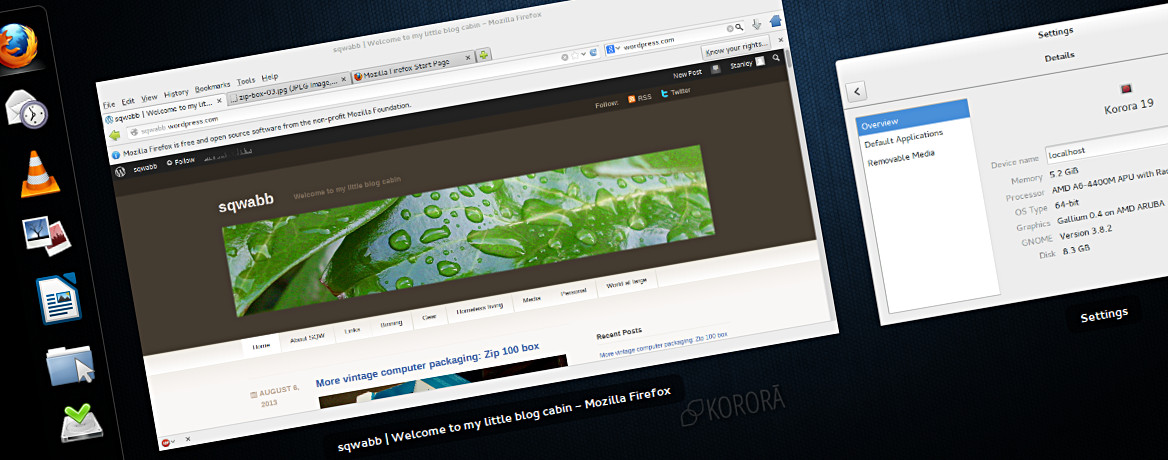 The Gnome 3.8.2 desktop of the Korora Gnome fllavour. There's also a high-calorie KDE Korora. Click the image to enlarge.[/caption]
I'm posting from a live USB boot of a Fedora-based, Linux distro called Korora, version 19. This is the first of the Linux distributions I've tested (including every Ubuntu from 12.04 to 13.10), which has been able to get on line using the HP Pavilion g6's built-in wireless card, a Ralink RT3290 802.11bgn Wi-Fi Adapter. I've not been a fan of Gnome 3, but, I could learn to love it. But one thing that interested me about Korara's Gnome version is that it's supposed to include the new "Gnome 2-ish" classic mode, which i assume can only be accessed in a full install. This review makes it sound like the Korora team is aiming at the Ubuntu audience. GIMP 2.8 is already installed, along with Firefox 22, and I noticed VLC. Nice.
The reviewer preferred the KDE version, but I confess that I have had too many negative experiences with KDE -- nothing has more trouble with the truncated resolution of a 10.1-inch netbook screen than a KDE application. "Yes Virginia, all the important application buttons are in the 40 pixels off the bottom edge of the Acer Aspire One's screen!"
Anyway, Korora 19 seems to run well on the Pavilion g6. One thing about the Live USB, made using the Windows version of Fedora's LiveUSB Creator, is that I didn't specify any persistence, yet I've been able to take screenshots, and save the (fuzzy) GIMP edit at the top of this post. I assume the saved file is only "saved" in RAM [it is], and won't be there on a second boot [it wasn't], but I didn't expect to be able to save anything. Shows how little I know.
 Update -- Korora connected to the flakey McWi-Fi at the Broadway and Granville McDonalds -- It's so bad now, I normally use a nearby signal. So the previous success, in the Waves coffee shop at Broadway and Spruce, wasn't a one-off. Click the image to see the full screen.
Cozying up to Windows 8 on the HP Pavilion g6 ►


Installing Ubuntu Linux on the HP Pavilion g6, which happily fell into my lap, will have to wait. Not because of UEFI, or Secure Boot, but because the wireless card -- the Ralink RT3290 802.11bgn Wi-Fi Adapter -- is too new for Ubuntu -- versions 12.04, and 12.10 couldn't see it at all, while Ubuntu 13.04 saw the card, and Wi-Fi networks, but couldn't connect to anything. Sadly, being able to simply download and install a Linux driver for the Ralink RT3290 is not an option, so far as I can see -- just not Linux-y enough.
 Linux distributions seem to unfurl, and fold like sheets at a laundromat. Now, another Linux distro I liked is gone. Fuduntu was discontinued in April, just as people were saying it was the best new Linux in years.
Fuduntu was created in late 2011, by Andrew Wyatt as a fork of Fedora Linux -- a sort of Fedora for the Ubuntu desktop crowd, tweaked for netbooks, and laptops. It came with an up-to-the-minute Linux kernel, apps like Chromium, Adobe Flash and Fluendo MP3 codecs, Thunderbird, Pidgin, and VLC. It used the Gnome 2 desktop, Fedora's YUM package manager, and it was a rolling release.
By early 2013, with version 2013.1, the Fuduntu team seemed to have a winning distro -- reviewers were loving it. I kind of loved it too. But it's repositories didn't include Synapse -- You just couldn't beat Ubuntu for software choices; and I was loathe to throw away all that time I'd invested memorizing how to spell "sudo." But, Fuduntu was definitely one to watch. By March, into April, Fuduntu version 2013.2 had Netflix and Steam in the repositories, and reviewers were having to dig deep into their reserve of superlatives. Then at the end of April, on the 28th, The Fuduntu website announced that the distribution was dead. The team was starting a new distribution, based on openSUSE, initially called FUse Linux, but now renamed Cloverleaf Linux (In Canada, Cloverleaf means canned tuna, for better or worse).
What seems to have killed Fuduntu, and I don't want to get too technical here (no chance of that), wasn't the Gnome 2 Desktop Environment as I originally wrote -- and as many others have written -- but rather it was underlying code libraries, including GTK. Another factor was Systemd, a new system services manager, adopted by Fedora in 2011. Andrew Wyatt explains here ►. Wyatt actually says of the Gnome 2 DE:
We had no issue with our GNOME 2 code base; it was mature and functional, and we had no problem supporting GNOME 2 itself at-all.
Interesting post about the future of Fuduntu, now that it's not Fuduntu ►
Oh FUD! Another look at the death of Fuduntu ►
[caption id="attachment_3377" align="alignnone" width="497"] I'd already seen the Windows 8 icon on the bottom of the laptop, but seeing the Metro Start screen was still a shock.[/caption]
The woman said it didn't work -- the HP Pavilion G6 pictured above -- that it was only good for parts. The yellow-tipped AC adapter was what caught my eye -- it looked right for the HP tank top. I told the woman if I did get it working, I'd wipe it clean, that I didn't care about her files, that I ran a different operating system. She had pretty, light hazel eyes that did "deer in headlight" beautifully. He boyfriend came out, having heard the salient points, and declared she didn't have anything on the laptop worth worrying about.
 I'd already seen the Windows 8 icon on the bottom of the laptop, but seeing the Metro Start screen was still a shock.[/caption]
The woman said it didn't work -- the HP Pavilion G6 pictured above -- that it was only good for parts. The yellow-tipped AC adapter was what caught my eye -- it looked right for the HP tank top. I told the woman if I did get it working, I'd wipe it clean, that I didn't care about her files, that I ran a different operating system. She had pretty, light hazel eyes that did "deer in headlight" beautifully. He boyfriend came out, having heard the salient points, and declared she didn't have anything on the laptop worth worrying about.
Ubuntu, trying hard not to look like the GNU/Linux of old, gives it's users a single graphical pipeline to install software over the Internet, called the Ubuntu Software Centre. But under the candy coating of the Unity graphical interface, all the old ways of installing software still work, and many would argue they still work much better than the user friendly, lumbering Software Centre -- I say it's good to have choices. One benefit of understanding the various methods, is that it gives you the freedom to install most any Linux software, not just the wares in the Software Centre.

The AC adapter that fits my HP Pavilion dv6k packed it in yesterday. It was a cheap-o multi adapter which reeled in the cords to save space. This seemingly handy feature doomed the thin cords to a hard life of wear-and-tear, and an early death from friction. So, for the moment, back to the good, old, Acer Aspire 533, which has been sitting in the storage locker and ... malfunctioning. Hardware-wise the left click had stopped working. OS-wise, Xubuntu 12.10 had lost window decorations -- you know, Close buttons-'n-stuff.
So, booting off the Ubuntu 12.04 live stick I always seem to have (I should force myself to try Linux Mint for more than three hours, right?), I was checking my blog, and installing. The public WiFi only cut out once (how many language packs does Ubuntu install?). Then almost by reflex in the Terminal, I sudo apt-got busy:
Post-install install:
- Gnome-panel (bye-bye Unity)
- Synapse (semantic launchers rule!)
- The GIMP 2.8 (how else to crop the photos on this blog?)
- qBittorrent 3.0 (It's a free country, and Bittorrent helps keep it that way!)
- Blogilo (a KDE offline blog editor. The best Linux can do, I think)
[caption id="attachment_1150" align="alignleft" width="233"]
 After the 15-inch HP, the Acer's screen is tiny -- better click the image.[/caption]
I also disable the overlay scroll bars (Ick!), and toggle mounted volumes and trash on the Desktop (I like the Apple-flavoured Ubuntu best).
After I get a new trailer, I'll save up and get a new multi-adapter for the HP, just so I can discover that the power supply is also kacked, but in the meantime, I want my Internet.
The "Standby" image is from here.
In truth, when I took up with Ubuntu last year, I did so out of necessity more than just curiosity; I jumped at opensouce because it offered me a shooting-chance at meaningful computing on the kind of garbage computers I could get. I chose Ubuntu because of the readily available live CD; the comfortingly Mac-like aspects of the 12.04 desktop, and because it truly made a silk purse out of the sow's ear of a netbook I was using. It's fair to say that if my Macbook Pro had not been stolen, I wouldn't have had any incentive to switch to Linux; I was already tinkering with it in VirtualBox, and that's likely all I would have done.
So, after a year-and-some of daily Ubuntu use, have I been converted or would I run back to Apple if I could?
First-off; I'm grateful for Gnu Linux and Ubuntu, etc., for being there so i could have productive computing on obsolete hardware. I also believe in the goals of the FOSS movement; the results speak for themselves. A lot of Linux distros do a lot of things right. Ubuntu has had the (perhaps unintended) effect of making me much more comfortable with the Command Line Interface. So, no. I wouldn't exactly be running back to the Mac.
My dream computer at this point would be a well-built PC laptop with great build quality and hardware specs and it would triple-boot the unholy trinity of Windows, OS X, and some sort of Linux. There are still great programs unique to operating systems (Irfanview comes to mind). I think the hardware wars of the 1990s are over, and I think software won. If I'm surfing the Web, using Firefox, let's say, my user experience will likely be identical regardless of the platform. That's what counts these days.
I'm one of the many homeless folk who seriously use computers. At this moment I'm running Ubuntu 12.04 LTS on an old HP Pavilion dv6000 - not so much a laptop as a tank-top.
I've been an Apple Mac user since 1990. In 2012 I turned to Linux, only because my MacBook Pro had been stolen. My older PPC G3 iBook couldn't cut it. I'd read how Ubuntu could revitalize an old computer; I tried it on a junker PC laptop; the results were impressive.
Ubuntu was not the daunting Linux I remembered from 2000. The live CD was a great idea. Ubuntu seemed to blend best practices from a number of operating systems.
My first serious install was Ubuntu 12.04. I played with all the Unity bells and whistles, but eventually settled on the Gnome Classic environment. Unity was a hog and not so flexible. I found a semantic launcher like Synapse was so much faster than the Dash or the H.U.D.
I've tried a variety of other desktop environment and Linux distros. But whether Linux Mint with Mate and Caja, or the cool Puppy Linux, or Fuduntu with it's lovely Gnome 2 DE, I have always come back to Ubuntu.
One reason is software availability and compatibility - Ubuntu gives me more freedom to install more software that works than any other distro I've tried. The other reason, it turns out, is the file manager.
Turns out the reason I Liked Linux in the first place was first-and-foremost because of Nautilus, the Gnome file manager used by Ubuntu. As a long-time Macintosh user, I was impressed to see Ubuntu mounted volumes on the desktop and used an expand/collapse folder toggle in directory windows, just like Apple's so-called "disclosure triangles." I was more impressed by Nautilus' Mac-like touches, when I saw how Windowsy the rest of the Ubuntu interface was.
Imagine my surprise to discover that Nautilus was originally created by Eazel, a company full of former Apple employees. The original Nautilus icons were designed by Susan Kare, the legendary designer of the core Macintosh icons. No wonder I like Nautilus!
Thanks to Nautilus, I actually kind of prefer file management in Ubuntu over Mac OS X. I love the F3 split-screen view in Nautilus. Boos and hisses to Gnome for doing away with that feature in Nautilus 3.6, and cheers to Canonical for sticking with the older 3.4.2 version of Nautilus for Ubuntu 12.10.
I've been an Apple Mac user since 1990. In 2012 I turned to Linux, only because my MacBook Pro had been stolen. My older PPC G3 iBook couldn't cut it. I'd read how Ubuntu could revitalize an old computer; I tried it on a junker PC laptop; the results were impressive.
Ubuntu was not the daunting Linux I remembered from 2000. The live CD was a great idea. Ubuntu seemed to blend best practices from a number of operating systems.
My first serious install was Ubuntu 12.04. I played with all the Unity bells and whistles, but eventually settled on the Gnome Classic environment. Unity was a hog and not so flexible. I found a semantic launcher like Synapse was so much faster than the Dash or the H.U.D.
I've tried a variety of other desktop environment and Linux distros. But whether Linux Mint with Mate and Caja, or the cool Puppy Linux, or Fuduntu with it's lovely Gnome 2 DE, I have always come back to Ubuntu.
One reason is software availability and compatibility - Ubuntu gives me more freedom to install more software that works than any other distro I've tried. The other reason, it turns out, is the file manager.
How Nautilus tricked me into liking Linux
Turns out the reason I Liked Linux in the first place was first-and-foremost because of Nautilus, the Gnome file manager used by Ubuntu. As a long-time Macintosh user, I was impressed to see Ubuntu mounted volumes on the desktop and used an expand/collapse folder toggle in directory windows, just like Apple's so-called "disclosure triangles." I was more impressed by Nautilus' Mac-like touches, when I saw how Windowsy the rest of the Ubuntu interface was.
Imagine my surprise to discover that Nautilus was originally created by Eazel, a company full of former Apple employees. The original Nautilus icons were designed by Susan Kare, the legendary designer of the core Macintosh icons. No wonder I like Nautilus!
Thanks to Nautilus, I actually kind of prefer file management in Ubuntu over Mac OS X. I love the F3 split-screen view in Nautilus. Boos and hisses to Gnome for doing away with that feature in Nautilus 3.6, and cheers to Canonical for sticking with the older 3.4.2 version of Nautilus for Ubuntu 12.10.
Subscribe to:
Posts (Atom)