Showing posts with label Windows. Show all posts
Showing posts with label Windows. Show all posts
[caption id="attachment_10099" align="alignnone" width="497"] Be vewy, vewy, quiet. Hunting the wascally Windows XP -- and penguins.[/caption]
Microsoft has a habit of using fear marketing to keep Windows customers from leaving the fold; for nearly 20 years they've tried to hold back the threat of open source software by sowing Fear, Uncertainty and Doubt about the Linux operating system; belittling it, calling it a cancer and ultimately claiming it infringes Microsoft's patents.
Lately, Microsoft has taken to throwing mud, or "FUD" as the technique is known, at its own popular operating system: Windows XP.
XP is still, after 13 years, the second most popular operating system, used on an estimated half billion computers.
But, except for a small percentage of enterprise customers using embedded XP under long-term service contracts, XP is dead to Microsoft. Both they and PC makers can only see a lot of potential new computer sales.
Be vewy, vewy, quiet. Hunting the wascally Windows XP -- and penguins.[/caption]Microsoft has a habit of using fear marketing to keep Windows customers from leaving the fold; for nearly 20 years they've tried to hold back the threat of open source software by sowing Fear, Uncertainty and Doubt about the Linux operating system; belittling it, calling it a cancer and ultimately claiming it infringes Microsoft's patents.
Lately, Microsoft has taken to throwing mud, or "FUD" as the technique is known, at its own popular operating system: Windows XP.
XP is still, after 13 years, the second most popular operating system, used on an estimated half billion computers.
But, except for a small percentage of enterprise customers using embedded XP under long-term service contracts, XP is dead to Microsoft. Both they and PC makers can only see a lot of potential new computer sales.

There's a clear pattern here: three times in a row now, or every seven years, Microsoft appears to have thrown a mediocre-to-bad version of Windows onto the market to buy time while it finishes the "good" version.
Today the problem is with Windows 8. Seven years ago it was with Windows Vista, and seven years before that the problem was with Windows ME.
[caption id="attachment_9964" align="alignnone" width="497"] One of the 95% of ATMs which NCR says are running Windows XP. -- 2fmagazine.com[/caption]
After 13 years Microsoft is about to finally turn off vital life support to the aging Windows XP operating system. But it's hard to properly say goodbye to XP, not because of love but because so many people still use it whether they want to or not.
On April 8, 2014, Microsoft will discontinue automatic security updates for Windows XP. Significantly, Microsoft says it will will also stop providing the XP-compatible Microsoft Security Essentials for download.
To say that this is going to create a huge security hole in the very fabric of human civilization may not be the overstatement it sounds like.
One of the 95% of ATMs which NCR says are running Windows XP. -- 2fmagazine.com[/caption]After 13 years Microsoft is about to finally turn off vital life support to the aging Windows XP operating system. But it's hard to properly say goodbye to XP, not because of love but because so many people still use it whether they want to or not.
On April 8, 2014, Microsoft will discontinue automatic security updates for Windows XP. Significantly, Microsoft says it will will also stop providing the XP-compatible Microsoft Security Essentials for download.
To say that this is going to create a huge security hole in the very fabric of human civilization may not be the overstatement it sounds like.

When Microsoft executive Stephen Elop took the reigns in 2011 as CEO at Finland's Nokia he wrote a company memo that compared Nokia's predicament -- surrounded on all sides by challenges -- to that of a man trapped on a burning oil rig. In such a circumstance, Elop said, a person -- or one of the world's premier cell phone makers -- had no choice but to jump.
The memo became famously known as the "burning platform" memo. And Elop, a Canadian, was widely praised for telling it like it was.
Elop succeeded in getting Nokia to jump... into the arms of Microsoft, and he pocketed a healthy $25 million profit for his trouble (after which his old employer rehired him).
The praise has taken a turn towards Greek tragedy as Elop is frequently compared to a Trojan horse.
Now that Elop is back at Microsoft he's even been suggested as a possible replacement for outgoing CEO Steve Ballmer. That's all the more reason to suggest that he jumped from one fire into another one.
Microsoft, in fact, has several burning issues on its plate. There's the matter of finding the next great leader and the matter of making the next great operating system.
A team at Microsoft headquarters in Redmond, Washington, is already hard at work building the replacement for the badly under-performing Windows 8 operating system.
[caption id="attachment_9463" align="alignnone" width="497"] 1960 ad for Ohio Art's Etch A Sketch. Look familiar?[/caption]
For better or worse the baby boomer generation of post-Second World War babies are amazing. Never have so many people been born in such a short time: Seventy-eight-or-so million children were born in the U.S. alone between 1945 and 1964 -- the broadest time span for Boomerdom.
Even their dreams are amazing: so many boomers have the same dreams at the same time, they can't help but become everyone's dreams.
I'm typing this post on one of those dreams: a laptop.
Boomers didn't invent computers, they invented personal computers, to replace the impersonal kind of main- and mini-frame computers their parents invented and which they used in colleges and universities around the world -- they were the most educated generation in human history after all.
1960 ad for Ohio Art's Etch A Sketch. Look familiar?[/caption]For better or worse the baby boomer generation of post-Second World War babies are amazing. Never have so many people been born in such a short time: Seventy-eight-or-so million children were born in the U.S. alone between 1945 and 1964 -- the broadest time span for Boomerdom.
Even their dreams are amazing: so many boomers have the same dreams at the same time, they can't help but become everyone's dreams.
I'm typing this post on one of those dreams: a laptop.
Boomers didn't invent computers, they invented personal computers, to replace the impersonal kind of main- and mini-frame computers their parents invented and which they used in colleges and universities around the world -- they were the most educated generation in human history after all.
[caption id="attachment_7705" align="alignnone" width="497"] There are computer viruses, malware, spyware, and the variously named Conduit Toolbars.[/caption]
Today I got to once again eXPerience Microsoft's most venerable, and vulnerable, operating system as I cleaned up the doo-doo after a friend's update of Adobe's desktop Flash.
Adobe thinks nothing of letting out-and-out spyware piggyback on it's Flash installers and updaters; it's called a "bundled download." Adobe give you the chance to disallow the third-party ware to install along with Flash,but you have to be paying attention. Lots of people trust Adobe, like my friend did. These days, trusting in Adobe updaters gets you not just Flash, but new Web browser features in the form of the Conduit Search spyware.
There are computer viruses, malware, spyware, and the variously named Conduit Toolbars.[/caption]Today I got to once again eXPerience Microsoft's most venerable, and vulnerable, operating system as I cleaned up the doo-doo after a friend's update of Adobe's desktop Flash.
Adobe thinks nothing of letting out-and-out spyware piggyback on it's Flash installers and updaters; it's called a "bundled download." Adobe give you the chance to disallow the third-party ware to install along with Flash,but you have to be paying attention. Lots of people trust Adobe, like my friend did. These days, trusting in Adobe updaters gets you not just Flash, but new Web browser features in the form of the Conduit Search spyware.
 I'm a little late in my reporting, but this year, in May, the International Space Station (ISS) dumped the last of it's laptop installations of the Windows XP operating system to go all Linux, and furthermore dropped Red Hat Linux in favour of Debian 6. According to the Linux Foundation, which provided two training courses geared specifically for the USA/NASA team’s needs.
[caption id="attachment_7407" align="alignnone" width="497"] Henry reflects on the Dell booting Ubuntu 12.04.3 off the USB stick. We used plain 12.04 to install though.[/caption]
My friend Henry is one of the worst things that can happen to a laptop. He can't explain it. They all break. The Acer Aspire One he spent an entire welfare cheque on -- broken. The enormous Toshiba he found beside a dumpster -- broken. And what about his latest dumpster find, the HP dv6000? Guess.
When he dove the dumpster that yielded the HP dv6000, he also fished out a Dell Inspiron 1525, with AC adapter. We got the HP up and working because, well, we could. The Dell had a password, and I didn't know the F-key to change the boot order on the Dell.
Well, Henry would rather have access to the Internet than not, so over breakfast two days ago at McDonald's I installed Ubuntu 12.04 on the Dell. After one little bobble, it went without a hitch. For the first time, Henry the binner and dumpster diver, and Windows user, would get to dive into Linux.
 Henry reflects on the Dell booting Ubuntu 12.04.3 off the USB stick. We used plain 12.04 to install though.[/caption]
My friend Henry is one of the worst things that can happen to a laptop. He can't explain it. They all break. The Acer Aspire One he spent an entire welfare cheque on -- broken. The enormous Toshiba he found beside a dumpster -- broken. And what about his latest dumpster find, the HP dv6000? Guess.
When he dove the dumpster that yielded the HP dv6000, he also fished out a Dell Inspiron 1525, with AC adapter. We got the HP up and working because, well, we could. The Dell had a password, and I didn't know the F-key to change the boot order on the Dell.
Well, Henry would rather have access to the Internet than not, so over breakfast two days ago at McDonald's I installed Ubuntu 12.04 on the Dell. After one little bobble, it went without a hitch. For the first time, Henry the binner and dumpster diver, and Windows user, would get to dive into Linux.

"There is nothing wrong with your computer. Do not attempt to adjust the picture. We are controlling transmission. ... We will control the horizontal. We will control the vertical. For the next hour (if you're lucky!), sit quietly and we will control all that you see and hear. You are about to experience the awful and mysterious way Microsoft automatically updates Windows, which reaches from the inner mind to... The Outer Limits of your patience!"
Apologies to the classic Outer Limits TV series -- see the 1963 opening ►
I can tweak Windows 8 to be fairly unobtrusive. I can disable, and hide the Metro/Modern interface. I can run Windows versions of most of the opensource programs I use in Ubuntu Linux. And I do like how fast Windows 8 boots up, and shuts down, But one thing I don't like is the awful way Windows 8 handles automatic operating system updates -- the same as Windows 7, which was the same way updates were handled in Windows Vista: When you least expect it, instead of your laptop shutting off, it informs you that it is "Configuring Windows updates," and whatever you do, "Do not turn off your computer." Both Ubuntu Linux, and Apple's Mac OS X can perform system updates in the background while you -- the User -- are using your computer. Windows does not seem to be able to install system updates while the User is logged in. You can't actually turn this off, but you can turn it down a little.
[caption id="attachment_5641" align="alignnone" width="497"] XP's polite way of telling you, your computer's hooped, your hard drive may be toast, in which case your files are history, and your computer never really liked you anyways![/caption]
Two days ago, I went from hero over breakfast to zero by dinnertime. After restoring the Wi-Fi in Henry's HP Pavilion dv6000 over breakfast, I later proved unequal to the task of pulling Jezi's Acer emachine back from the brink of Windows Registry Hell. I did, at least, show her all her files were intact, accessible, and therefore recoverable.
 XP's polite way of telling you, your computer's hooped, your hard drive may be toast, in which case your files are history, and your computer never really liked you anyways![/caption]
Two days ago, I went from hero over breakfast to zero by dinnertime. After restoring the Wi-Fi in Henry's HP Pavilion dv6000 over breakfast, I later proved unequal to the task of pulling Jezi's Acer emachine back from the brink of Windows Registry Hell. I did, at least, show her all her files were intact, accessible, and therefore recoverable.
Yesterday did not go according to plan at all. My free time was completely eaten up by OPCPs -- Other People's Computer Problems. I wasn't able to fix the second OPCP: Jezzi's Acer, but I was able to solve the first one over breakfast.
OPCP number one: Henry's laptop gains Windows 7, but loses it's wireless
[caption id="attachment_5625" align="alignnone" width="497"] After the fix, Henry searches for "server pack," rather than "service pack."[/caption]
Homeless Henry had a nice Toshiba laptop, but by June, he hadn't. Something went wrong -- the laptop equivalent of shaken baby syndrome, I think. This week Henry found two working laptops in one evening: An HP Pavilion dv6000, and a Dell Inspiron. The Dell looked to be the better, newer, laptop, but had a password. The HP Pavilion, on the other hand, like a junker car, was completely unlocked. I saw both laptops the morning after Henry found them. The HP went online effortlessly, but Henry couldn't log onto his Facebook page -- the same problem we'd had with his Toshiba, for the same reason -- the HP "thought" the year was 2006, it's manufacture date. Fixing the date allowed Henry to get onto his Facebook page.
My so-called "tank-top" is also a dv6000, but not identical to Henry's, which seems older. It's product number is: rn914ua#abl. The HP Product Specifications for that number don't sound worse, but I subsequently pimped my dv6000's specs considerably.
OPCP number one: Henry's laptop gains Windows 7, but loses it's wireless
[caption id="attachment_5625" align="alignnone" width="497"]
 After the fix, Henry searches for "server pack," rather than "service pack."[/caption]
Homeless Henry had a nice Toshiba laptop, but by June, he hadn't. Something went wrong -- the laptop equivalent of shaken baby syndrome, I think. This week Henry found two working laptops in one evening: An HP Pavilion dv6000, and a Dell Inspiron. The Dell looked to be the better, newer, laptop, but had a password. The HP Pavilion, on the other hand, like a junker car, was completely unlocked. I saw both laptops the morning after Henry found them. The HP went online effortlessly, but Henry couldn't log onto his Facebook page -- the same problem we'd had with his Toshiba, for the same reason -- the HP "thought" the year was 2006, it's manufacture date. Fixing the date allowed Henry to get onto his Facebook page.
My so-called "tank-top" is also a dv6000, but not identical to Henry's, which seems older. It's product number is: rn914ua#abl. The HP Product Specifications for that number don't sound worse, but I subsequently pimped my dv6000's specs considerably.

"Business are open?" They say "truth is the first casualty of war." I don't know about that -- and I don't know who they are -- I'm Canadian -- a nationality equivalent to low-impact aerobics. "War" is a great song I grew up hearing on the radio. I can, however, vouch for the fact that spelling is often the first casualty of technology, A good example, aside from the above LED sign, which is "Too Good To Be Forgotten" (2G2B4G in SMS text-speak), is the old 1990s eight-dot-three file naming convention in the Windows operating system. People learned to strip the vowels out of file names they were creating, and put them back in file names they were reading, so Windows98,doc became "wndws98.doc." Sounds like fun, huh?

 Anchors aweigh! Florida Pete found this very tasty old HP laptop, a Pavilion zt1170 -- very high in iron. I could only wonder what it would've tipped the scales at if it still had it's hard drive.. The specs were pretty good for a laptop that I thiought came out in 2002. It was old enough that, it didn't have built-in wireless, and while it had USB ports, it had no USB boot option, and I had no bootable CDs with me.
 It sure had lots of ports, on the sides, the back, even one on the bottom!. The early 2000s was a time of transition, so a computer manufacturer had to cover their behind. Must have made it all the harder to make a small form factor laptop. Certainly was by the evidence at hand.
While I searched around on the Net for info on this behemoth, Pete booked out beside me and headed for Slumberland. Before I left, I woke him up. He bade me a good evening, and went back to sleep. I paused outside McDonalds to worry about the safety of his shopping cart. I left it and hoped for the best, but not before I seriously considered tying the HP Pavilion to one of the wheels. Click the images to enlarge them.
[caption id="attachment_4382" align="alignnone" width="497"] Well... Halo runs on Xbox doesn't it?[/caption]
How sad. Microsoft could be competitive in less than a year. The Redmond-based software-and-hardware company announced today that Chief Executive Officer Steve Ballmer would be stepping down within 12 months. Microsoft stock rose nine per cent on the news.
Steve Ballmer went to college with Microsoft founders Bill Gates, and Paul Allen, and started with Microsoft in 1980. He became CEO of Microsoft in 2000, after Bill Gates stepped down.
Ballmer is said to be smart as a whip, but he's always come off publicly as more than a bit of a clownish huckster. Elevation to Microsoft's CEO in 2000 only magnified his "bull in a china shop" optics. Steve Ballmer had the misfortune of becoming Microsoft CEO the same year Steve Jobs became Apple's self-proclaimed "iCEO" In the i-era, Jobs completely out-general-ed, out-coached, and outmaneuvered Ballmer at every turn. Ballmer probably couldn't have helped Apple more if he had worked for them. He blithely, and blindly laughed at, and ridiculed, each of the iProducts, as they pushed Apple back into profitability, and, in 2012, past Microsoft in market capitalization.
Ballmer seriously hated on opensource and Linux, infamously calling Linux, "a cancer that attaches itself in an intellectual property sense to everything it touches." ► Balmer repeatedly threatened to sue opensource developers for patent infringement. Even without merit backing up it's claims, the threats alone, given Microsoft's legal resources, were designed to have a chilling effect on the opensource movement.
Steve Ballmer tenure as CEO has been a near-total disaster for Microsoft. Under his tenure, Apple came back from the dead to become a thriving innovative tech darling, and opensourse, with Google's help, has come out of nowhere to dominate cell phones. Microsoft has repeatedly been caught off-guard, and left playing catch-up against it's rivals. It's responses: Zune for the iPod, Vista for OS X, Windows 8 Phone for Android, and Surface for the iPad, have all failed.
Microsoft's board has reportedly begun the process to replace Steve Ballmer as CEO. Ballmer himself is quoted in Microsoft's announcement as saying:
Wrong again Steve -- 13 year, and 7 months ago, would've been a perfect time. From all the Apple users, and Linux users you slagged, and tried to terrorize with your "fear-leading" tactics: Don't let the door hit you on the way out!
Well... Halo runs on Xbox doesn't it?[/caption]How sad. Microsoft could be competitive in less than a year. The Redmond-based software-and-hardware company announced today that Chief Executive Officer Steve Ballmer would be stepping down within 12 months. Microsoft stock rose nine per cent on the news.
Steve Ballmer went to college with Microsoft founders Bill Gates, and Paul Allen, and started with Microsoft in 1980. He became CEO of Microsoft in 2000, after Bill Gates stepped down.
Ballmer is said to be smart as a whip, but he's always come off publicly as more than a bit of a clownish huckster. Elevation to Microsoft's CEO in 2000 only magnified his "bull in a china shop" optics. Steve Ballmer had the misfortune of becoming Microsoft CEO the same year Steve Jobs became Apple's self-proclaimed "iCEO" In the i-era, Jobs completely out-general-ed, out-coached, and outmaneuvered Ballmer at every turn. Ballmer probably couldn't have helped Apple more if he had worked for them. He blithely, and blindly laughed at, and ridiculed, each of the iProducts, as they pushed Apple back into profitability, and, in 2012, past Microsoft in market capitalization.
Ballmer seriously hated on opensource and Linux, infamously calling Linux, "a cancer that attaches itself in an intellectual property sense to everything it touches." ► Balmer repeatedly threatened to sue opensource developers for patent infringement. Even without merit backing up it's claims, the threats alone, given Microsoft's legal resources, were designed to have a chilling effect on the opensource movement.
Steve Ballmer tenure as CEO has been a near-total disaster for Microsoft. Under his tenure, Apple came back from the dead to become a thriving innovative tech darling, and opensourse, with Google's help, has come out of nowhere to dominate cell phones. Microsoft has repeatedly been caught off-guard, and left playing catch-up against it's rivals. It's responses: Zune for the iPod, Vista for OS X, Windows 8 Phone for Android, and Surface for the iPad, have all failed.
Microsoft's board has reportedly begun the process to replace Steve Ballmer as CEO. Ballmer himself is quoted in Microsoft's announcement as saying:
“There is never a perfect time for this type of transition, but now is the right time.”
Wrong again Steve -- 13 year, and 7 months ago, would've been a perfect time. From all the Apple users, and Linux users you slagged, and tried to terrorize with your "fear-leading" tactics: Don't let the door hit you on the way out!

 Nothing too special. Was in McDonalds, across the street from the Royal Bank on the North-East corner of Broadway and Granville. I was stuck in one of those conversations that occur in public places with complete strangers (well if they were complete strangers they wouldn't have been talking to me, would they?) I gazed across the street and saw this lone fellow, washing the face of the building -- cameras are handy. Always carry one, working or not; a camera can help you get out of conversations with strangers, "Excuse me, I MUST blog this," and get into conversations with strangers, "Excuse me ma'am, may I take your photo for my blog? I know, it's sad when you need props. Click the image to enlarge it.
[caption id="attachment_4203" align="alignnone" width="497"] When I first saw the attractive Fuduntu cloverleaf logo, which embodied an "f" for Fedora, I suppose, I thought it also, evoked the Windows logo, and the Apple cloverleaf key.[/caption]
I've continued to gnaw away at why Funduntu turned out the lights; I'm like a none-too-bright dog -- and no, that's not a Puppy Linux crack. I love Puppy.
Of course Andrew Wyatt, and company would rightly say they've explained why, but I didn't quite get it (see above dog reference). So I've been reading, back to 2010, and forwards to just a few months ago. For better or worse, here's what I get: Fedora's a bit of a mess under the hood (and they didn't have enough mechanics), and the Fuduntu team wore their name like an albatross around their collective neck for nearly three years. The former explains rebasing on OpenSUSE, and the latter explains the new name for the new distribution.
When I first saw the attractive Fuduntu cloverleaf logo, which embodied an "f" for Fedora, I suppose, I thought it also, evoked the Windows logo, and the Apple cloverleaf key.[/caption]I've continued to gnaw away at why Funduntu turned out the lights; I'm like a none-too-bright dog -- and no, that's not a Puppy Linux crack. I love Puppy.
Of course Andrew Wyatt, and company would rightly say they've explained why, but I didn't quite get it (see above dog reference). So I've been reading, back to 2010, and forwards to just a few months ago. For better or worse, here's what I get: Fedora's a bit of a mess under the hood (and they didn't have enough mechanics), and the Fuduntu team wore their name like an albatross around their collective neck for nearly three years. The former explains rebasing on OpenSUSE, and the latter explains the new name for the new distribution.

Wherein I pine for Apple's Preview, and Quick Open, but console myself by installing Irfanview in Windows 8.

They say absence makes the heart grow fonder. Well, I couldn't be any fonder of Apple's Preview application than I am right now, toying with Microsoft's "pieces o' eight" operating system. Preview is part of the Mac OS. Double clicking on PDFs, JPEGs, GIFs, TIFFs,, and 25 other image file types, automatically opens them in Preview. It's a cornerstone of the Macintosh User Interface. Users generally take it for granted -- until they don't have it anymore.
[caption id="attachment_3750" align="alignnone" width="497"] Penguins love apples! Click the image to go to the source page.[/caption]
Gotta love the future. People are always announcing the great things they're going to do there. Probably why there's a lineup to get in. For instance, in the future we'll be able to run Mac OS X programs in Linux! At least that's the goal of The Darling Project, which is hard at work, trying to create a "compatibility layer" approach to running Apple's Macintosh OS X applications within Linux, exactly the way the program Wine allows Windows programs to run in Linux. There is nothing to download yet, but this sort of "sexy" opensource effort grabs attention -- It grabbed mine.
Penguins love apples! Click the image to go to the source page.[/caption]Gotta love the future. People are always announcing the great things they're going to do there. Probably why there's a lineup to get in. For instance, in the future we'll be able to run Mac OS X programs in Linux! At least that's the goal of The Darling Project, which is hard at work, trying to create a "compatibility layer" approach to running Apple's Macintosh OS X applications within Linux, exactly the way the program Wine allows Windows programs to run in Linux. There is nothing to download yet, but this sort of "sexy" opensource effort grabs attention -- It grabbed mine.
[caption id="attachment_3722" align="alignnone" width="497"] The Gnome 3.8.2 desktop of the Korora Gnome fllavour. There's also a high-calorie KDE Korora. Click the image to enlarge.[/caption]
I'm posting from a live USB boot of a Fedora-based, Linux distro called Korora, version 19. This is the first of the Linux distributions I've tested (including every Ubuntu from 12.04 to 13.10), which has been able to get on line using the HP Pavilion g6's built-in wireless card, a Ralink RT3290 802.11bgn Wi-Fi Adapter. I've not been a fan of Gnome 3, but, I could learn to love it. But one thing that interested me about Korara's Gnome version is that it's supposed to include the new "Gnome 2-ish" classic mode, which i assume can only be accessed in a full install. This review makes it sound like the Korora team is aiming at the Ubuntu audience. GIMP 2.8 is already installed, along with Firefox 22, and I noticed VLC. Nice.
The reviewer preferred the KDE version, but I confess that I have had too many negative experiences with KDE -- nothing has more trouble with the truncated resolution of a 10.1-inch netbook screen than a KDE application. "Yes Virginia, all the important application buttons are in the 40 pixels off the bottom edge of the Acer Aspire One's screen!"
Anyway, Korora 19 seems to run well on the Pavilion g6. One thing about the Live USB, made using the Windows version of Fedora's LiveUSB Creator, is that I didn't specify any persistence, yet I've been able to take screenshots, and save the (fuzzy) GIMP edit at the top of this post. I assume the saved file is only "saved" in RAM [it is], and won't be there on a second boot [it wasn't], but I didn't expect to be able to save anything. Shows how little I know.
 Update -- Korora connected to the flakey McWi-Fi at the Broadway and Granville McDonalds -- It's so bad now, I normally use a nearby signal. So the previous success, in the Waves coffee shop at Broadway and Spruce, wasn't a one-off. Click the image to see the full screen.
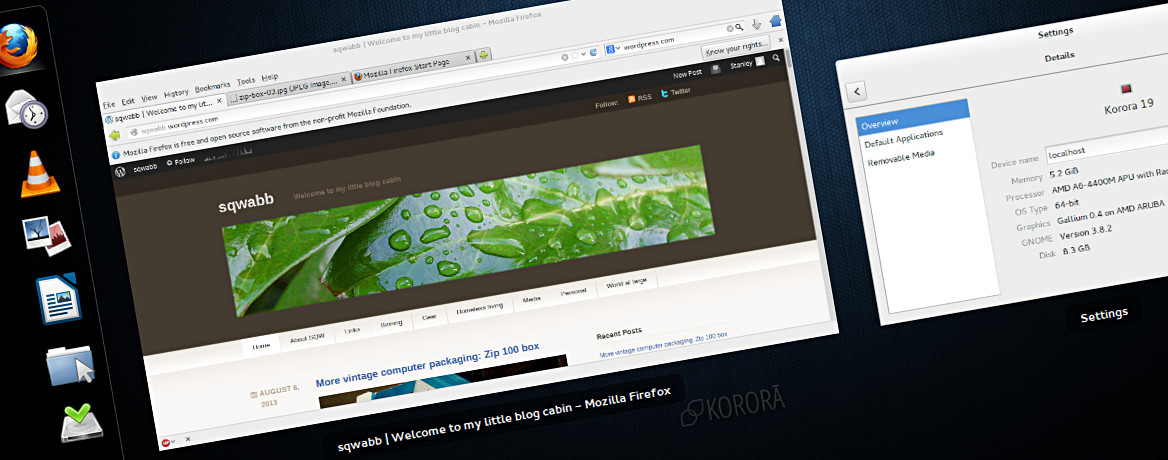 The Gnome 3.8.2 desktop of the Korora Gnome fllavour. There's also a high-calorie KDE Korora. Click the image to enlarge.[/caption]
I'm posting from a live USB boot of a Fedora-based, Linux distro called Korora, version 19. This is the first of the Linux distributions I've tested (including every Ubuntu from 12.04 to 13.10), which has been able to get on line using the HP Pavilion g6's built-in wireless card, a Ralink RT3290 802.11bgn Wi-Fi Adapter. I've not been a fan of Gnome 3, but, I could learn to love it. But one thing that interested me about Korara's Gnome version is that it's supposed to include the new "Gnome 2-ish" classic mode, which i assume can only be accessed in a full install. This review makes it sound like the Korora team is aiming at the Ubuntu audience. GIMP 2.8 is already installed, along with Firefox 22, and I noticed VLC. Nice.
The reviewer preferred the KDE version, but I confess that I have had too many negative experiences with KDE -- nothing has more trouble with the truncated resolution of a 10.1-inch netbook screen than a KDE application. "Yes Virginia, all the important application buttons are in the 40 pixels off the bottom edge of the Acer Aspire One's screen!"
Anyway, Korora 19 seems to run well on the Pavilion g6. One thing about the Live USB, made using the Windows version of Fedora's LiveUSB Creator, is that I didn't specify any persistence, yet I've been able to take screenshots, and save the (fuzzy) GIMP edit at the top of this post. I assume the saved file is only "saved" in RAM [it is], and won't be there on a second boot [it wasn't], but I didn't expect to be able to save anything. Shows how little I know.
 Update -- Korora connected to the flakey McWi-Fi at the Broadway and Granville McDonalds -- It's so bad now, I normally use a nearby signal. So the previous success, in the Waves coffee shop at Broadway and Spruce, wasn't a one-off. Click the image to see the full screen.
Cozying up to Windows 8 on the HP Pavilion g6 ►


This mint condition Zip drive box lists requirements like System 8.5 for Mac, and Pentium 100 for Wintel, and touts the Zip Drive's support for "new" USB -- That pegs the date no earlier than 1997-1998. It boggles the mind that people might be hanging on to this stuff for real, for 15 years. There was no corresponding Zip Drive in the dumpster, so either the box outlived the hardware, or someone is still backing up their stuff in teaspoon-sized portions (100 MB, maybe 250 MB), or, are we perhaps seeing a new fad among the well-to-do? Are people going on Ebay and buying the packaging for obsolete, antique electronics, or is there an industry to produce painstakingly-accurate facsimile reproductions? -- all so people can throw it away? I, for one, wouldn't be surprised.
Zip drives are certainly a thing of the past -- completely superseded in the first years of the 21st Century by flash drives -- but when they were introduced in 1994, they were a revolutionary innovation. They changed the rules for portable storage devices. Before inexpensive Zip drives, there were a few options for backing up large volumes of data. These are the ones I remember from the early 1990s:
Subscribe to:
Posts (Atom)