Showing posts with label Fedora. Show all posts
Showing posts with label Fedora. Show all posts
[caption id="attachment_4203" align="alignnone" width="497"] When I first saw the attractive Fuduntu cloverleaf logo, which embodied an "f" for Fedora, I suppose, I thought it also, evoked the Windows logo, and the Apple cloverleaf key.[/caption]
I've continued to gnaw away at why Funduntu turned out the lights; I'm like a none-too-bright dog -- and no, that's not a Puppy Linux crack. I love Puppy.
Of course Andrew Wyatt, and company would rightly say they've explained why, but I didn't quite get it (see above dog reference). So I've been reading, back to 2010, and forwards to just a few months ago. For better or worse, here's what I get: Fedora's a bit of a mess under the hood (and they didn't have enough mechanics), and the Fuduntu team wore their name like an albatross around their collective neck for nearly three years. The former explains rebasing on OpenSUSE, and the latter explains the new name for the new distribution.
When I first saw the attractive Fuduntu cloverleaf logo, which embodied an "f" for Fedora, I suppose, I thought it also, evoked the Windows logo, and the Apple cloverleaf key.[/caption]I've continued to gnaw away at why Funduntu turned out the lights; I'm like a none-too-bright dog -- and no, that's not a Puppy Linux crack. I love Puppy.
Of course Andrew Wyatt, and company would rightly say they've explained why, but I didn't quite get it (see above dog reference). So I've been reading, back to 2010, and forwards to just a few months ago. For better or worse, here's what I get: Fedora's a bit of a mess under the hood (and they didn't have enough mechanics), and the Fuduntu team wore their name like an albatross around their collective neck for nearly three years. The former explains rebasing on OpenSUSE, and the latter explains the new name for the new distribution.
[caption id="attachment_3722" align="alignnone" width="497"] The Gnome 3.8.2 desktop of the Korora Gnome fllavour. There's also a high-calorie KDE Korora. Click the image to enlarge.[/caption]
I'm posting from a live USB boot of a Fedora-based, Linux distro called Korora, version 19. This is the first of the Linux distributions I've tested (including every Ubuntu from 12.04 to 13.10), which has been able to get on line using the HP Pavilion g6's built-in wireless card, a Ralink RT3290 802.11bgn Wi-Fi Adapter. I've not been a fan of Gnome 3, but, I could learn to love it. But one thing that interested me about Korara's Gnome version is that it's supposed to include the new "Gnome 2-ish" classic mode, which i assume can only be accessed in a full install. This review makes it sound like the Korora team is aiming at the Ubuntu audience. GIMP 2.8 is already installed, along with Firefox 22, and I noticed VLC. Nice.
The reviewer preferred the KDE version, but I confess that I have had too many negative experiences with KDE -- nothing has more trouble with the truncated resolution of a 10.1-inch netbook screen than a KDE application. "Yes Virginia, all the important application buttons are in the 40 pixels off the bottom edge of the Acer Aspire One's screen!"
Anyway, Korora 19 seems to run well on the Pavilion g6. One thing about the Live USB, made using the Windows version of Fedora's LiveUSB Creator, is that I didn't specify any persistence, yet I've been able to take screenshots, and save the (fuzzy) GIMP edit at the top of this post. I assume the saved file is only "saved" in RAM [it is], and won't be there on a second boot [it wasn't], but I didn't expect to be able to save anything. Shows how little I know.
 Update -- Korora connected to the flakey McWi-Fi at the Broadway and Granville McDonalds -- It's so bad now, I normally use a nearby signal. So the previous success, in the Waves coffee shop at Broadway and Spruce, wasn't a one-off. Click the image to see the full screen.
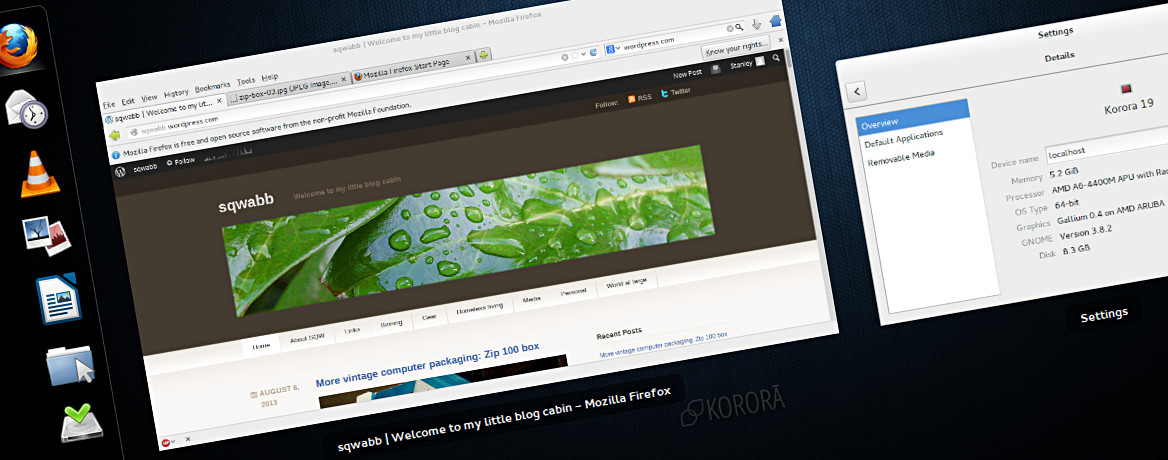 The Gnome 3.8.2 desktop of the Korora Gnome fllavour. There's also a high-calorie KDE Korora. Click the image to enlarge.[/caption]
I'm posting from a live USB boot of a Fedora-based, Linux distro called Korora, version 19. This is the first of the Linux distributions I've tested (including every Ubuntu from 12.04 to 13.10), which has been able to get on line using the HP Pavilion g6's built-in wireless card, a Ralink RT3290 802.11bgn Wi-Fi Adapter. I've not been a fan of Gnome 3, but, I could learn to love it. But one thing that interested me about Korara's Gnome version is that it's supposed to include the new "Gnome 2-ish" classic mode, which i assume can only be accessed in a full install. This review makes it sound like the Korora team is aiming at the Ubuntu audience. GIMP 2.8 is already installed, along with Firefox 22, and I noticed VLC. Nice.
The reviewer preferred the KDE version, but I confess that I have had too many negative experiences with KDE -- nothing has more trouble with the truncated resolution of a 10.1-inch netbook screen than a KDE application. "Yes Virginia, all the important application buttons are in the 40 pixels off the bottom edge of the Acer Aspire One's screen!"
Anyway, Korora 19 seems to run well on the Pavilion g6. One thing about the Live USB, made using the Windows version of Fedora's LiveUSB Creator, is that I didn't specify any persistence, yet I've been able to take screenshots, and save the (fuzzy) GIMP edit at the top of this post. I assume the saved file is only "saved" in RAM [it is], and won't be there on a second boot [it wasn't], but I didn't expect to be able to save anything. Shows how little I know.
 Update -- Korora connected to the flakey McWi-Fi at the Broadway and Granville McDonalds -- It's so bad now, I normally use a nearby signal. So the previous success, in the Waves coffee shop at Broadway and Spruce, wasn't a one-off. Click the image to see the full screen.
Cozying up to Windows 8 on the HP Pavilion g6 ►
 Linux distributions seem to unfurl, and fold like sheets at a laundromat. Now, another Linux distro I liked is gone. Fuduntu was discontinued in April, just as people were saying it was the best new Linux in years.
Fuduntu was created in late 2011, by Andrew Wyatt as a fork of Fedora Linux -- a sort of Fedora for the Ubuntu desktop crowd, tweaked for netbooks, and laptops. It came with an up-to-the-minute Linux kernel, apps like Chromium, Adobe Flash and Fluendo MP3 codecs, Thunderbird, Pidgin, and VLC. It used the Gnome 2 desktop, Fedora's YUM package manager, and it was a rolling release.
By early 2013, with version 2013.1, the Fuduntu team seemed to have a winning distro -- reviewers were loving it. I kind of loved it too. But it's repositories didn't include Synapse -- You just couldn't beat Ubuntu for software choices; and I was loathe to throw away all that time I'd invested memorizing how to spell "sudo." But, Fuduntu was definitely one to watch. By March, into April, Fuduntu version 2013.2 had Netflix and Steam in the repositories, and reviewers were having to dig deep into their reserve of superlatives. Then at the end of April, on the 28th, The Fuduntu website announced that the distribution was dead. The team was starting a new distribution, based on openSUSE, initially called FUse Linux, but now renamed Cloverleaf Linux (In Canada, Cloverleaf means canned tuna, for better or worse).
What seems to have killed Fuduntu, and I don't want to get too technical here (no chance of that), wasn't the Gnome 2 Desktop Environment as I originally wrote -- and as many others have written -- but rather it was underlying code libraries, including GTK. Another factor was Systemd, a new system services manager, adopted by Fedora in 2011. Andrew Wyatt explains here ►. Wyatt actually says of the Gnome 2 DE:
We had no issue with our GNOME 2 code base; it was mature and functional, and we had no problem supporting GNOME 2 itself at-all.
Interesting post about the future of Fuduntu, now that it's not Fuduntu ►
Oh FUD! Another look at the death of Fuduntu ►
Subscribe to:
Posts (Atom)