

Japanese-Canadian Barista's "generic" mocha, with no "conscious" attempt at "latte art," depicts the Adam embryo from the anime Neon Genesis Evangelion! What else could it be? The design obviously comes from the deep, shared zeitgeist of the Japanese culture. Evangelion is the national anthem, constitution, and Goethe, of Japan, all rolled into one. Sure it is. Click the images to enlarge them.
 Ha. Tengo el brazo! ¿Qué es esto? Oh, no ... Rocket Punch![/caption]
A few mornings ago, I was having breakkfast at McDonalds, and sitting a seat away from Maurice, who up and said to me, "Hey Stanley, you like old things. There was this cartoon I liked..."
Maurice is someone I see, and talk to in McDonalds. He's a polite young man, at least ten years younger than I am. He was born and raised in El Salvador, and came to Canada at the end of the 1980s. English is his second language, and he's soft-spoken to boot, so I often strain to catch his entire meaning. But this time, there was no doubt he was describing a Japanese mecha anime.
 I quized him about the look of the giant robot, the human characters, and the basic plot. At one point, he described a chubby robot, and I thought he was referring to the granddaddy of all super robots, Tetsujin 28-go (renamed Gigantor for the US) from 1956, but no, the chubby giant robot he was referring to wasn't the star, but a secondary character.
One boxed Super Robot : DAIDEJIN


A 1984 Super Robot by Bandai America (Made in Japan) from their Godaikin series of Super Robots. Item #377033. This is a die-cast metal, transforming toy:
"DAIDENJIN, the robot is transformed into DENJIN, the spaceport, with a few moves here and there."


Unfortunately the box, which is in very bad shape, only included Daidenjin, and his two alternate "Big Punch" hands. So I'm missing the Denjin Sword, Denjin Boomerang, Denjin Ball, and the missiles.
According to the original price tag, the toy was purchased at Mannings, a chain of department stores in Hong Kong, and Macau, for $75.00. This one just sold on Ebay, last month -- complete in original box -- for $266.00 US.
Daidenjin, it turns out, is a mecha character from an ancient Super Sentai television series called Denshi Sentai Denziman (1980-1981), Power Rangers-like TV Show made by Toei, hence Toei's copyright credit on the box, along with TV Asahi, and M.C.G. Daidenjin ("giant electic man") was the first transforming robot in a Super Sentai series.
 The American Jaeger Gypsy Caravan playing hide-and-seek with a Kaiju in Hong Kong.[/caption]
Pacific Rim, if you haven't heard, is a recently-released, would-be Summer blockbuster film, directed by Guillermo del Toro, starring almost no one you've heard of, and released by Legendary Pictures. It tells a science fiction, action-adventure story built around two Japanese genres: mecha (Japanese for "kids in giant robots") and kaiju (Japanese for "guys in rubber monster suits"). Based on the trailer, and the track record of previous American efforts with anime, I was sceptical ►, and so, apparently, have been North American movie audiences ►. I've finally seen the movie -- three times.
To be blunt, the actual movie didn't really start for me until about 20 minutes into the running time: The anti-kaiju wall is breached in Sydney, Australia. We get an exciting snippet of the Aussie Jaeger whupping a Kaiju in broad daylight!
When I say it starts, I don't mean it starts cleanly. This obviously finely crafted machine has been left in low gear too long, so it coughs, and sputters a bit as it revs up. When the Jaeger program boss Marshall Stacker Pentecost (Idris Elba) is trying, gruffly, to woo the American, former Jaeger pilot, Raleigh Becket (Charlie Hunnam) back into the Jaeger program, he caps his sales pitch with: "Haven't You heard? The World is comming to an end! Where would you rather die: Here, or in a Jaeger?" I thought dying in my seat at that low point would've been a mercy.
But then, The Marshall's personal assistant, Mako Mori (Rinko Kikuchi) finally arrives -- only 23 minutes late -- the gang's all here, and the movie begins to show real signs of life. The Jaeger program has it's back to the wall; all that's left has been garthered up in Hong Kong -- that's only four Jaegers -- the elegant Chinese Grab Hand, the very, old-school Russian Bucket Head, the macho Australian Rocket-Chest (Bustgunner was taken), and the swaggering American Gypsy Moth. Everything, and everyone connected with the Jaeger program is cooped up in something called the Shatterdome, which includes two wacky Kaiju researchers, a so-called "Kaiju-groupie," (Charlie Day), and his very pent-up boss, Dr. Hermann Gottlieb (Burn Gorman). I din't warm up to Charlie Day immediately, but Burn Gorman, Owen Harper from Torchwood, among other things, was a treat to watch from his first scene. The pair's interplay is good comic relief from all the histrionics.


Giant robots need dysfunctional people -- we know this, and with so many of them together under one roof, we get real emotional fireworks, and not-so-pent-up physical aggression, and several helpings of back-story trauma, until the movie finally, fully, roars to life with an incredible scene where Mako Mori relives her chilhood encounter with a Kaiju (played poignantly by Mana Ashida). The difference with Mako the child, is that Mako the adult is in a Jaeger with her finger on a plasma cannon -- wow!
The rest of the movie pretty much just rocks. It moves fast enough that you no longer have time to ponder the flaws and inconsistencies. The emotional intensity, and the scale of the visuals are finally in synch. The movie just flies. The final battle scenes -- progressing from bay, to port, to downtown Hong Kong are relentless, and breathtaking. One scene, in the city battle, which is already famous, culminating in a Newton's Cradle on a desk, should leave you gasping at director Guillermo del Toroo's skill, and chutzpah. Oh, and a mecha finally uses a sword to dispatch a Kaiju.
The climactic ending, was satisfyingly explosive, allowed the audience to see Mako Mori in her shiny black plugsuit one more time, and left everything up in the air for a sequel. Great stuff! Click the Mako Mori stills to enlarge them.
Pacific Rim may also be starting slow at the box office. It seems obvious the film was built to succeed in the international market, but in large chunks of the world it still hasn't opened. It doesn't hit theatres in Japan, for instance, until August 5th.
[caption id="attachment_3028" align="alignnone" width="497"]
 Nono, the starry-eyed girl, is on fire![/caption]
| Title: | Aim for the Top 2! DieBuster | ||
| Studio: | Gainax | ||
| Air date: | October 3, 2004 – August 14, 2005 | ||
| Episodes: | 6 |
DieBuster is a six-episode OVA produced by Gainax to help mark their 20th anniversary as a studio -- it is a sequel to their ground-breaking 1988 six-episode OVA GunBuster (my review).
Tens of thousands of years after the events of Aim for the Top! GunBuster, when the Human race desperately fought malevolent space monsters to a standstill, the Space Monsters are still out there; still a threat. Humans are restricted to the massively terraformed planets and moons of their solar system. When they look into their night skies, they see the wall of Space Monsters as the so-called Red Milky Way. The only thing keeping the Monsters at bay is a fraternity of psychically-gifted teenagers known as Topless, and the ancient, and awesome biomechanical Buster machines only they can pilot.
 The Jaeger is © Legendary Pictures. Minions are © Felonious Gru. Click on the image to enlarge it[/caption]
Pacific Rim's lacklustre opening weekend shows anime themes still don't have mass market appeal in North America, but there's always the rest of the world to consider.
Pacific Rim, which opened July 12, came third in North American weekend box office receipts, with only $38.3 million US, behind Despicable Me 2, with $44.8 million US, and even the Adam Sandler comedy Grown Ups 2, with $42.5 million US. according to The Hollywood Reporter. ► Pacific Rim finishes it's opening weekend with an estimated worldwide box office total of $91.3 million US. Despicable Me 2, in it's second week of release, finished the same weekend period with a worldwide box office of $100.5 million, making it's total global box office $472.4 Million US.
Various sources estimate Pacific Rim cost at least $190 million US. Various sources report the budget for Despicable Me 2 was 76 million US, and for Grown Ups 2, around $80 million.
The Hollywood Reporter article attributes what success Pacific Rim had to "fanboys," citing strong IMAX sales, which they describe as "the favored venue for fanboys." Basically it's a weird movie which has appeal for geeks and otaku fanboys, but not the mass audience of normal people necessary for blockbuster success.
Everyone expects Pacific Rim will perform well in Japan, and other Asian countries. In fact, the filmmakers may have anticipated the cool North American response. With it's story featuring an international alliance of 21 nations -- each getting their own nationally-themed Jaeger robot, for a kind of anti-kauju World Cup -- Pacific Rim might be a rare American film designed, and engineered to succeed, first and foremost, in the international market.
My personal review of Pacific Rim ►
[caption id="attachment_3104" align="alignnone" width="497"]
 One of the Police Labors getting a thorough going-over for maintenance.[/caption]
| Title: | Patlabor: The Movie |
| Studio: | Studio Deen / IG Tatsunoko |
| Air date: | 1989 |
| Episodes: | 1 |
In the Patlabor universe, Labors are sophisticated, heavy machines, usually in humanoid form, that allow their human operators to perform difficult, or dangerous tasks, with dexterity, precision, and power. By 1999, when this movie takes place, Labors are commonplace, in heavy industry, on construction sites, even on the battlefield. Police forces have also had to become experts in Labor technology, to both use it themselves, and to solve crimes involving the ubiquitous machines.
The story opens with a dramatic suicide, and follows with an even more dramatic take-down, of a military Labor, which has run amok without a human operator. Enter the Tokyo Metropolitan Police Department's small, but capable, 2nd Special Vehicles Section (SV2), after a Tokyo construction Labor, again without a human operator, turns itself on and goes berserk, right in front of a member of the SV2. These operator-less malfunctions are happening as Greater Tokyo is in the midst of a massive, and "Labor"-intensive, urban renewal program, including the Babylon Project, which is constructing islands in Tokyo Bay.
[caption id="attachment_3107" align="alignright" width="186"]
 The Microsoft, I mean the Hypersoft, um, the Hyper Operating System, which has a virtual monopoly on Labor Computers.[/caption]
SV2 learns that all the malfunctioning Labors -- in fact 80 per cent of the 60,000 Labors in the Tokyo area -- had their computer systems upgraded to a revolutionary new OS, the Hyper Operating System 1.0, and that the genius programmer who wrote it, just committed suicide by jumping off the Babylon Project's HQ in Tokyo Bay.
As evidence mounts of a deliberate plot to cause all the Tokyo Labors to malfunction simultaneously, SV2's commander, Captain Gotoh, and his small team have to solve the mystery, and stop the threat, without causing a panic, and without running afoul of powerful political and business interests.
Real Robots done real good
Patlabor is a franchise which began life as a manga (1988-1994), and was adapted into a 6-episode OVA (1988-1989), and anime series (1989-1990). That's to say the Patlabor universe was well established by the time of this 1989 movie, so it starts right in telling the story as if it's happening in the real world. So no giant magically-powerful robots piloted by precocious,dysfunctional children, just robots as work-a-day machines, requiring regular maintenance, and operated by trained, adult professionals, like crane, or backhoe operators, except police Labor operators get GIANT handguns with explosive shells, they have to load manually with both hands.
[caption id="attachment_3111" align="alignnone" width="497"]
 Investigating the mysterious programmer. Nothing flashy. Just the facts ma'am.[/caption]
Patlabor: The Movie, and the sequel Patlabor 2: The Movie (1993), differ from the rest of the Patlabor franchise -- in a word, the movies are cinematic. Where the other Patlabor anime, as I recall, gets pretty frantic, and almost slapstick, the movies both hew to thematic, and visual realism. The world of Patlabor movies is full of nuts and bolts, and personal issues, and political agendas. The mecha is a big part of the characters' lives, but they have lives. The pacing, and direction of both films, by Mamoru Oshii, is never cartoony. The scenes of the investigators methodically tracking the programmer's past -- which are among my favourite scenes in any anime -- are in deliberate contrast to the rest of the action. They move through the film slowly, with little dialogue, but against stunning visuals, and haunting music by composer Kenji Kawai.
Both movies have high production values, across the board -- animation, music, sound work -- the movie budget is really on the screen. If there is a flaw, it's one I think is common to many anime films of this period, trying hard to be taken seriously -- they talk a lot.
Director Mamoru Oshii, and composer Kenji Kawai worked together on both the Patlabor films, and, two years later, in 1995, on the Ghost in the Shell movie.
Next in the series: Aim For the Top 2! DieBuster ►
Patlabor Next Generation live action film announced for 2014 ►
[caption id="attachment_2964" align="alignnone" width="497"]
 GunBuster rising to the challenge. Definitely the 80s, look at that hair, and those shoulder pads. Click the image to enlarge.[/caption]
| Title: | Aim for the Top! GunBuster |
| Studio: | Gainax |
| Air date: | October 7, 1988 – July 7, 1989 |
| Episodes: | 6 |
In the not-so-distant future, Humankind has ventured out into deep space, and gotten in big trouble by making it's presence known to space monsters who can warp across interstellar distances, and who are mutely, and aggressively hostile to Human life. There's nothing for the Human race to do but develop giant fighting robots, and train kids to pilot them. The story opens in the year 2023 -- six year after the destruction of the Luxion Fleet by Space Monsters -- at one of the many schools around the world where young men and women train in large mecha robot suits, to pilot the GunBuster weapon, a new giant fighting robot -- only two pilots from each school will be chosen.
[caption id="attachment_2969" align="alignnone" width="497"]
 Noriko looking all ninja-like, taking her training seriously. Click the image to enlarge.[/caption]
The main character is Noriko Takaya, an emotional, immature young woman, lacking confidence, and so prone to blubbering, you want to smack her on the nose with a rolled up newspaper! How she even qualified? She's the daughter of the dead Luxion Fleet commander -- that explains it for the other students. Noriko is taken under the wing by Kazumi Amano, the class phenom she idolizes. A new teacher, "Coach" Ohta -- the only survivor of the Luxion disaster, joins the school -- naturally Kazumi crushes on him. He, in turn, takes Noriko in tow, and shows her what she can do with "hard work and guts!" Noriko gets the message, and, along with Kazumi, advances to the GunBuster program. That's nearly two of the six episodes. What follows is more drama, melodrama, angst, suspense, hard work, and guts, than you can shake a stick at. The wonder of it all is that it makes for such a great anime. You can read a very good plot synopsis here.
GunBuster is both a product of it's time, and ahead of the curve. It shamelessly leverages what was popular at the time, particularly high school, and sports-themed animes, like Aim for the Ace. But when it shifts into full space opera mode, it enters new, uncharted territory, and delivers a visual and emotional punch on a scale hard to describe, and perhaps never equalled. The final episode, featuring action on a vast intergalactic scale, is famously done in black and white, and delimits the climactic battle to still images, which actually magnifies the impact in the mind's eye. The animation style of GunBuster has stayed quite fresh, to my eye at least, unlike most of it's contemporaries, like the 1988 Appleseed film, also produced by Gainax. The soundtrack of GunBuster is big and brassy, exactly in tune with the visuals.
[caption id="attachment_2971" align="alignnone" width="497"]
 Catching the wreck of the Luxion -- not so easy! GunBuster touches on hard science like the relativistic effects of space travel. Click the image to enlarge.[/caption]
GunBuster was, I believe, the second major effort by the young studio Gainax. They drew on the popular anime of the day, and threw in lots of their own new ideas. As mecha anime, it incorporates elements of both the older Super Robot, and newer Real Robot genres. It is definitely a case of the whole equalling more than the parts. It's success helped make the studio's reputation, influenced other anime producers, and paved the way for Gainax's Neon Genesis Evangelion.
[caption id="attachment_2945" align="alignright" width="300"]
 Noriko Takaya walking the walk in BustGunner, I mean GunBuster -- It's not prurient, It's physics, damn it!
[/caption]
GunBuster featured female characters in leading roles; Gainax was made up of anime fans, and realized the largely male audience would accept, and prefer, female characters in male roles, if the women were attractive, and showed a wee bit of nudity -- this was know as fan service. Gainax also brought new realism to their anime -- everything looked, and moved more three-dimensionally. One sort of "realism" relates back to fan service, and became known as the "Gainax bounce."
I have no idea where to get Aim for the Top! GunBuster. on DVD. I'm sure it's available, if you look hard enough. Twenty year later, Gainax produced a sequel OVA called DieBuster, which will be the subject of a future post.
Next in the series: Patlabor: The Movie ►
 With the mecha anime-"influenced" American action film Pacific Rim scheduled to open just days from now, I've been thinking not so much about whether I'll like Pacific Rim, but about the mecha anime series I already like. Here's the first of a series of posts then, on my favourites -- not exactly in order of preference.
[caption id="attachment_2846" align="alignnone" width="497"]
 Renton, and, Eureka, on the Nirvash, surrounded by sky fish.
[/caption]
Eureka Seven
| Title: | Psalms of Planets : Eureka seveN |
| Studio: | Bones |
| Air date: | April 17, 2005 – April 2, 2006 |
| Episodes: | 50 |
In a distant future on an Earth-like planet, where people and machines can literally surf the sky, both civil war, and alien invasion are in progress. Government, and rebels oppose each other using giant robot-like craft called LFO. The rebels are personified by a group called Gekkostate, led by a swashbuckling character named Holland; he, and most of his group are former soldiers from the military forces they now fight. This civil war is a result of the ongoing invasion/infestation of the planet by an alien something called Scrub Coral, and it's manifestations called Coralians. The authorities treat it as a threat to be destroyed, and have suppressed the truth that Scrub Coral is sentient, and may be seeking coexistence with humans. The rebels are trying to reveal the truth -- they believe coexistence is the only path for survival.
[caption id="attachment_2852" align="alignnone" width="497"]
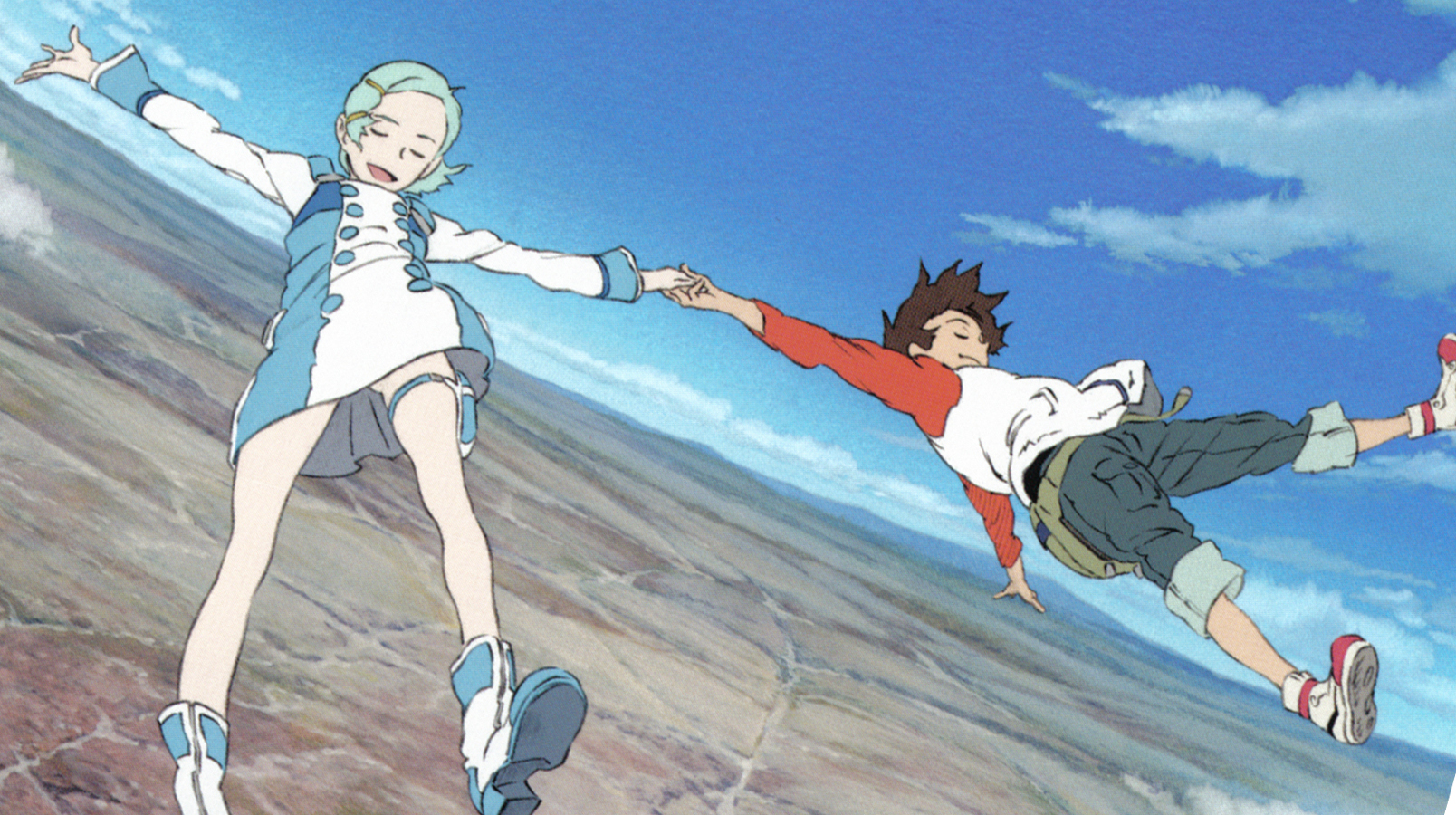 Eureka and Renton falling head over heels for each other.[/caption]
At it's heart, Eureka Seven tells the story of a 14-year-old boy, Renton Thurston, and Eureka, a turquoise-haired, lavender-eyed, Coralian girl; how they grow and mature, how love blooms between them, and how their love becomes the fate of their world. When the pair first meet, Eureka is with Gekkostate, piloting the giant robot-like craft called Nirvash typeZERO. Renton just happens to have a device called an Amita drive, which can awaken the full potential of the Nirvash. That Amita Drive has previously, and inexplicably, displayed the word "Eureka" to Renton several times.
[caption id="attachment_2851" align="alignnone" width="497"]
 Here's all of Gekkostate. Holland is the one with the cravat.[/caption]
Eureka Seven unpeels it's vast story, and the hidden connections between it's ever-growing cast of great characters, over the course of 50 episodes. We're talking the fate of the Human species, whether it will end in hope or dread. Eureka Seven is very much a mecha anime, in that giant fighting robots piloted by children are front and centre in the story, but it is anything but mechanical storytelling. It takes a character-driven approach to telling an epic tale. It also has a sense of humour.
The animation in Eureka Seven is at a consistently high level. The large number of aerial combat sequences are treated very three-dimensionally. The character designs are all visually interesting, and sometimes downright arresting. As is normal, for an anime which will spawn toys, each character has a stock costume; abnormally, in Eureka Seven, several characters change their look radically to underline changes in their outlook on life. The music is a high point. The soundtrack is integral to the scenes.
I can't say whether I consider Eureka Seven to be better than Neon Genesis Evangelion. I think thematically, and dramatically, NGE aimed higher than it could possibly reach, meaning, I think lots of it is incredibly great, and some of it is not so great, while I think Eureka Seven attains a consistently high level from beginning to end.
The original Eureka Seven was followed up by a theatrical anime in 2009: Eureka Seven: good night, sleep tight, young lovers, subtitled Pocket Full of Rainbows. It is set in an alternate universe, to say the least, and features all the principal characters from the original series, but in completely different roles; it is both mesmerizing, and confusing. I wonder if it's the universe as reimagined by Eureka, and Renton, but that would be telling. In 2012, a proper sequel series began, called Eureka Seven: AO -- I haven't seen this yet, but it's by the original studio, Bones. The original series has been available on DVD for years, here's a link to a six-disk boxed set on Amazon. ► Click the images to enlarge them.
Two technical points: I prefer to watch anime in the original Japanese, with English subtitles; the Japanese voice actors, or seiyu, are often remarkable performers. In the case of Eureka Seven, the Japanese cast is fabulous. The character of Renton, is voiced wonderfully by Yuuko Sanpei, a woman who specializes in voicing adolescent male characters. There are series where I think the English dubs are just as good as the original Japanese, such as FLCL. However, what I found exciting and profound about Eureka Seven in it's original Japanese, became dull and wooden in the English dub. Yikes!
Next in the series: Aim for the Top! GunBuster ►
 This film doesn't even have good stills! But click the image to enlarge it anyways.[/caption]
Blockbuster movies starring the Pacific Ocean have a poor track record. It's been little more than a year since audiences told Universal Pictures, "We sunk your battleship!" Now comes Pacific Rim, a science fiction, action-adventure film, set to open July 12. The trailers I've watched make it look an awful lot like Transformers, and Battleship, and Cloverfield, all rolled together -- and, did I mention "awful?"

Right just now, I'm re-acquainting myself with one of Japanese manga, (comic book) creator Masamune Shirow's. franchise creations -- Appleseed (published 1985-1989). It was his earlier, reputation-making series, and paved the way for his best-known manga: Ghost in the Shell (published 1989-1990). Ghost in the Shell led to an outstanding 1995 theatrical film anime of the same name, and then, anime TV series, video games, film sequels, and more manga -- it's what you'd call a multimedia franchise.