Encorp Pacific, the industry-based group that oversees the Return-It bottle depot system, unveiled the new Express concept last year to depot operators, and described it as an important new way to further increase beverage container recycling rates. Encorp described the Express experience like so:
"Return-It™ Express will offer a fast "in depot" experience. Customers create an online account from home, collect empties in a standard blue recycle bag, bring them to an Express location, confirm their name and the number of bags on a touch screen and drop off the bags at the Express window. The customers Depot visit is complete."
Payment is through the customer's online account.
Encorp say the Express concept will increase container recycling, and points to the success of similar systems in Newfoundland, Maine and Oregon. The key to the Express depot is a major change behind the scenes: a central counting centre.
"The goal of the Count Centre is to remove the depots' labour requirement to sort and count single stream material by leveraging efficiencies and technology for greater performance."
Blah, blah, blah. Under this kind of scheme, recycling rates could increase dramatically, but so would costs. All the sorting that is currently done by customers for free, would become paid work. Is this where the binners come in -- as low-paid sorting labour? Because under this system they certainly can't be customers.
Another benefit Encorp envisions is reduced space requirements for depots (note that Encorp doesn't refer to bottle depots -- just depots).
"Our goal is to help increase potential revenue streams for depot owners and increase their profitability."
How could centralizing sorting -- which will actually add new expense to the system -- increase "potential revenue streams" and profitability?
- Removing bottle sorting from individual depots reduces redundancies and increases throughput, allowing depots to handle more potential volume.
- Removing bottle sorting frees floor space so depots can earn fees accepting more kinds of recyclables on behalf of other B.C. Product Stewardship groups besides Encorp.
The 17 industry-based Product Stewardship groups are charged under legislation with implementing post-consumer recycling plans for a huge range of consumer products. Each group needs to have drop-off points. Naturally they're turning to the existing network of Return-It bottle depots. That's potentially a lot of money in handling fees for depot operators -- if they can make some room.
 Go Green's Anthony Ryder totaling-up on the new touch screen system.[/caption]
Sixteen years of tradition came to an end today as the Go Green bottle depot stopped counting bottles manually and began using a touch screen computer system. The Point of Return Application has been used by most Return-It bottle depots for over a decade. It's designed to simplify the process of counting a customer's bottles by allowing front counter staff to simply enter totals for pre-defined beverage container types. The system does the math and provides the customer with a detailed receipt.
 Rough visualization of an "instant" bottled depot.[/caption]
Every neighbourhood in Vancouver plays host to a variety of binners who fish the neighbourhood's stream of returnable beverage containers. Unfortunately not every neighbourhood can have a permanent bottle depot; because... there are no suitable locations, leases are too expensive, resident will allow it when you-know-where freezes over.
But every neighbourhood has an empty lot, or an empty storefront. I'd like to see single-day, pop-up bottle depots, which, with suitable advance advertising, could partially meet the need for a depot in any neighbourhood, rich or poor. Like, say... Kitsilano, which is still without a new bottle depot.
 These new container bins are not off to a promising start.[/caption]
Since their introduction along West Broadway, I've seen very, very, few returnable containers in Encorp's new Return-It container bins; just lots of trash. Despite the blue paint job, and the blaring signage -- not to mention there being a grey garbage bin beside each one of them -- supposedly recycling-savvy Vancouverites are taking them for just one more place to throw their food wrappers, and drink cups, and dog poop.
To be fair, I've only sampled the bins along the stretch between Cambie Street in the east to Blenheim Street in the west. That's just under 5 km. A much shorter distance than Google first thought it was.
Wait a minute, how are they supposed to empty the full bins if they're sitting on my patio or in my shed? And where do I put my cardboard garbage again? Click the image to enlarge it.

 It was many garbage bags like this that made today half-ways profitable.[/caption]
If recycling is almost "hip" a remarkable number of people show their disdain for fashion by continuing to throw all their recyclables, including their returnable containers, in the trash. Some binners will actually argue that many of these people are doing this to be nice to "real" get-their-hands-dirty binners. Bwahaha! Who says binners can't be funny? While I believe there are some who trash their containers knowing the hardcore binners will find them, I believe more people do it to make those "lazy so-and-so's" work for their bottles. But I'm sure the majority just want to throw things away and forget about them.

 Chris is a card-carrying member of this garage band. His space brings to mind Santa's workshop, with just a hint of mad scientist. And consider how Victor von Frankenstein might have turned out if, rather than graveyards, he'd had Vancouver's alleys to scour for materials. That's where Chris finds the
 [caption id="attachment_4867" align="alignnone" width="497"]
 Here he's used an old meat grinder to make a light fixture, and he has plans for some baking pans he found.[/caption]
Chris explained how he was turning to his skill with lighting to generate some income since being hit by a car a while back. The accident left him with serious injuries and he was unable to continue in type of work he had been doing. He said he currently had one paying lighting project on the go, so we can hope, as the saying goes, that the future looks bright.
Chris "shops" the lanes of the Kerrisdale neighbourhood (about 30 blocks South of Broadway Avenue), where he naturally finds lots of cool stuff. Here he shows off two real prizes: An old, seemingly mint condition, Fisher-Price medical kit, and Spider-Man board game, also in great shape, probably dating from the early 1970s. The box cover illustration sure looks like it's by the great John Romita, Sr. Click the images to enlarge them.
[caption id="attachment_4869" align="alignnone" width="497"]
 Drool all you want, you'll just mess up your computer screen.[/caption]
Another "garage band" member ►


This big white elephant is one of the City of Vancouver's fleet of, 30-or-so, Top Select-brand garbage trucks, designed specifically to collect the wheeled bins the city uses for apartment building recycling (blue bins), and single-family, residential, garbage (grey bins). This truck has strayed into a lane in Fairview, and may be a ways off it's patch -- the city contracts collection of apartment blue bins in Kitsilano, Fairview, and Mount Pleasant (all adjacent neighbourhoods) to a private garbage disposal company. What's a bit interesting here, is that the the truck got itself stuck. I'm not sure if they actually came in contact with the pole on their right, or the red car on their left, but they were having a time of it. When the truck finally came abreast of me, the driver leaned out her window, and actually asked me -- me, with the bike, and trailer, and bottles -- if the red car was mine. Probably because she saw me snapping pictures? Click on the images to enlarge them.

 Laura certainly makes recycling look like fun, doesn't she? Her drop technique is pretty wonderful (it's all in the wrist!), and the way she styles up for a trip to the blue bins is, quite simply, awesome. If she's brought out none of her non-recycleable garbage to throw away, it may be because the dumpster is a different colour. Wow! Click the images to enlarge them.


Recycling blue bins and dumpsters are disappearing around my Fairview neighbourhood. To be sure, it's happening slowly, so a lot of binners don't see it. I happened to trade binning for hourly-wage employment between January 2008 and January 2010, and when I started binning again, in May 2010, the reduction in accessible dumpsters and blue bins was glaringly obvious. Lots of dumpsters which had been accessible for years, were padlocked, or locked behind new wood, or steel, gated enclosures. Worse yet -- often the new locked enclosures held the dumpsters and the blue bins. Where I could speak to the managers of buildings who'd closed off access to all their trash and recyclables, I received the same basic answer -- It was to stop people from being able to illegally dump garbage in the dumpsters -- locking up the blue bins was just incidental. Uh-huh. But, I'm familiar with the phrase "killing two birds with one stone." Binning isn't always performed tidily, and it's a lie to say it can always be done quietly. If locking up the blue bins means binners can't root through them at four in the morning, then, quite literally, residents aren't going to lose sleep over it.
That said, the blue bins really are often just a casualty of the building managers war on illegal dumping in their dumpsters, from, to mention a few:
- Renters moving out of the neighbourhood, producing a steady stream of trash -- the contents of their fridges, their furniture, TVs, mattresses; whatever they don't want to move, they want to toss, and they don't care where.
- Fly-by-night construction trades people -- one person operations with a guy, a truck, and tools, operating out of their homes or apartments. they dump their construction waste wherever. earning at least a "drive-by-other people's-dumpsters-at-night" designation.
- Dog owners. Small potatoes by comparison, but when they deign to pick up after their dogs, they throw the little bags of their pet's poop everywhere -- in anyone's dumpster, garbage bin, recycling bin, whatever -- drives some building managers nuts.
This is all about money of course. The buildings pay for dumpster use, effectively by volume. So they pay more for illegal dumping in their dumpsters. But, by locking away their dumpsters, buildings lose the benefit of binners reducing the volume of their garbage. For the binners, a shrinking supply of returnable containers, and other re-purposeable, and re-sellable materials reduces their income potential, or, at least, reduces their return on effort. And the City of Vancouver loses out on the goal of diversion -- keeping things out of the landfills.

 Above: The day before they ripped up the parking lot to extract an old, rusted, oil tank, I watched the building manager install the camera (circled in red). He told me the camera was to deter people illegally dumping garbage in the building's dumpster, not to watch binners. Hmm.
Above top: There are many tasteful examples of how to enclose your dumpster and recycling blue bins -- this is not one of them. It seems one building manager has gone squirrelly over illegal dumping. Click the images to enlarge.
I'm not recycling when I collect returnable containers out of the recycling blue bins, but I am recycling when I get them out of dumpsters, and the garbage; some days, 20 per cent of my returnables come out of dumpsters. And there is an entire rank of binners who focus on dumpster diving -- they keep literally tons, and tons of returnable containers, and all types of resellable merchandise out of our landfills. I should say that a lot of the more professional dumpster divers are adept at acquiring keys for the various lock types, so they aren't so inconvenienced by locked dumpsters, but that's a small proportion of binners.
Dumpster keys explored and explained ►
See the love for dog owners on the front of the "No Dumping" building ►
The snotty-green dumpster enclosure disappears! ►
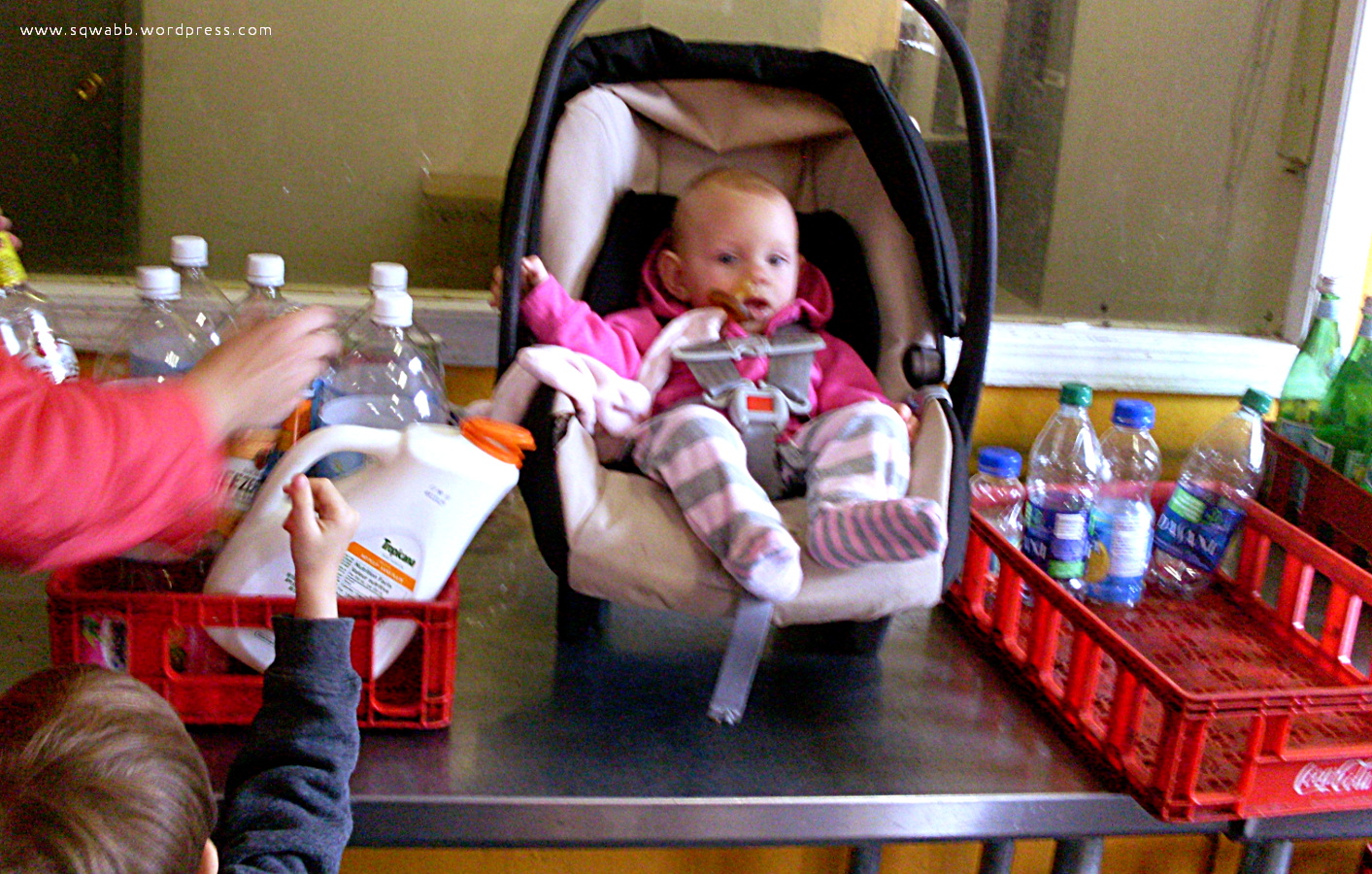 I'm sorry ma’am, there's no deposit on babies![/caption]
Almost the end of May, and Vancouver is submerged in, what is forecast to be, a dreary, grey, rain-soaked week. Well, If it was like Fall outside today, that may be partly because nine-month-old Summer was inside the Go Green bottle depot, with her mother Sam, and an unidentified brother. Click the somewhat blurry image to enlarge.
Check out another Sunny in Shaughnessy ►
This large, shallow dumpster full of old bricks, appeared in a Fairview alley off 16th Avenue, near Granville Street. Nothing near it was being demolished. Today I talked to two workers bringing wheelbarrows full of brick rubble to the dumpster; it took two of them to lift, and empty each wheelbarrow into the dumpster.
While one worker, Marco, was occupied with not having his face photographed, the other worker explained, there was no demolition. The building adjacent to the dumpster was merely being renovated -- the entire brick cladding was being removed -- merely renovated indeed! He didn't say what was replacing it. He also didn't say exactly what would happen with all that old brick, because he didn't know.
I use to think old bricks were stronger than new ones because they'd been subjected to years of compression, and were thus sought after for new construction, but I can find no evidence of this on the Internet. Bricks can, I read, be recycled in two ways. If they are intact, they can be reused. Their distinctive, aged look, suits them for heritage restoration, or the appearance of heritage in a new construction. Otherwise, apparently, old bricks are crushed and used as aggregate for concrete, and road construction. Click on a image for a gallery view.
 This is one of the flattering ones! Click image to enlarge.[/caption]
Over a year, two years ago, unflattering caricatures began appearing in blue toter bins around the Fairview area. I honestly didn't get it at first, then one day I was checking a toter and the caricature had a bike helmet daubed with bright orange paint -- I had a bright orange helmet. ... It was easy to guess the crazy culprit. I won't identify him, but his name rhymes with "Bill." Kind of sad for him to have somebody so much in your head like that, but, I decided, if he wanted to spend his time drawing pictures of me, rather than binning, then why should I complain? Many of these caricatures disappeared as bins were replaced, or scrubbed clean, and the culprit stopped adding new ones.

 Here's Bradley helping out as a Go Green sorter. As a binner, Bradley's been known to carry this much in -- in garbage bags, riding a bike with no seat and only one wheel, smiling all the way. When Bradley is not up to his elbows in bottles, he can be seen on select rooftops helping to divert planes around sensitive bird sanctuaries and wetland areas. click the image at left to enlarge.

Delicious foot-long hot dogs, the camaraderie of peers, and little female garment factory employees, all against the backdrop of the warmest Spring day in Super-natural Vancouver, B.C. made Customer Appreciation Day at the Go Green bottle depot, a day to remember. And I got a T-shirt (thanks Katharine).

 Above: Go Green's owner Anthony rates the occasion. Above, top: Anthony's son is thrilled to spend his Saturday serving hot dogs to the hobos! Left: A disappointing no-show. Where was Return-It Man?
Additional entertainment came in the form of little women on their breaks from a nearby garment factory. They certainly tried to get their hands on the hot dogs, and anything else that wasn't nailed down -- got away with all the frisbees didn't they? Ha, ha. So sorry ladies. No bottles, no hot dogs!